| Sign In | Join Free | My infospaceinc.com |
|
| Sign In | Join Free | My infospaceinc.com |
|
| Categories | Automatic Capping Machine |
|---|---|
| Model Number: | CM100 |
| Product name: | Automatic One Head Screw Capping Machine |
| MOQ: | 1 SET |
| Delivery Time: | 30 Work days |
| Bottle type: | Plastic Bottle Glass Bottle Cans |
| After-sales Service Provided: | Online Support Video Technical Support |
| Payment Terms: | L/C,D/A,D/P,T/T,Western Union |
| Applied bottle height: | 100-600mm |
| Applied cap diameter: | 20-130mm |
| Bottle cap type: | Screw Cap Ect |
| Usage: | Plastic Glass Metal Bottle Capping |
| Certification: | CE, SGS |
| Material: | Aluminum Alloy+Stainless Steel |
| Price: | $6299-$7799/1set |
| Capping speed: | 20-45bottle/min |
| Application: | Plastic Glass Bottle Capping |
| Supply Ability: | 1000Sets / year |
| Advantage: | Easy Operation High Efficiency |
| Power: | 1500W, 110V/220V, 50/60Hz |
| Place of Origin: | Shanghai, China |
| Operation: | PLC+touch Screen |
| Packaging Details: | WOODEN CASE |
| MOQ: | 1 Set |
| Brand Name: | YIMU |
| Function: | Multifunction |
| Company Info. |
| Shanghai Yimu Machinery Co., Ltd. |
| Verified Supplier |
| View Contact Details |
| Product List |
Full Automatic High Speed Single Head Plastic Glass Metal Bottle Capping Machine Manufacturer With OEM ODM Services
Cap torque is the single most important variable in bottle capping — and the most frequently uncontrolled. Every closure type, from a simple continuous-thread plastic cap on a water bottle to a child-resistant metal lug cap on a pharmaceutical jar, has an optimal torque range. Below this range, the cap may loosen during transport, leading to leakage, contamination, and product loss. Above this range, the cap may be difficult for the end user to open, the bottle neck threads may strip, or — in the case of glass containers — the finish may crack entirely.
The challenge is that torque requirements vary dramatically by application. A 28mm beverage cap may require only 1.5-2.5 N·m of application torque. A 110mm industrial drum bung may require 25-35 N·m. A child-resistant pharmaceutical closure requires a specific push-and-turn motion profile rather than simple rotation. Traditional mechanical and pneumatic capping systems apply a fixed level of force regardless of the closure type, making them inherently imprecise.
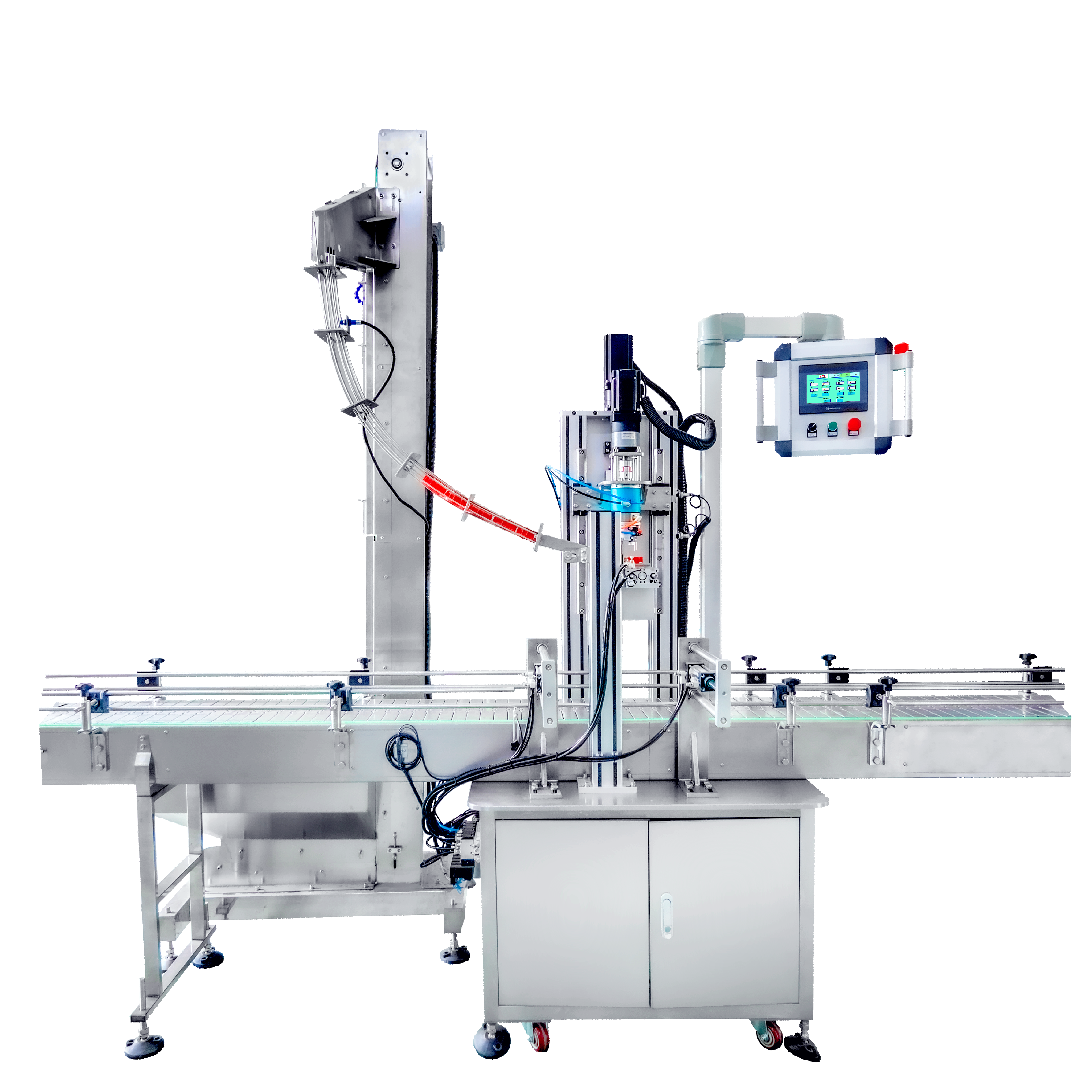
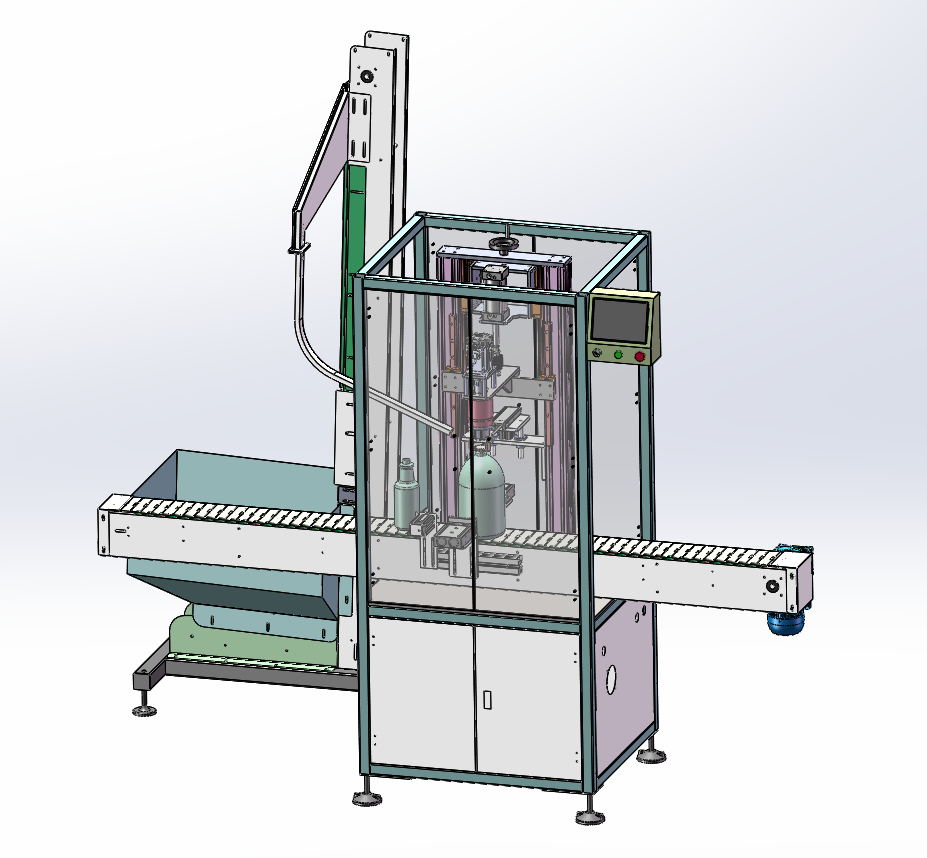
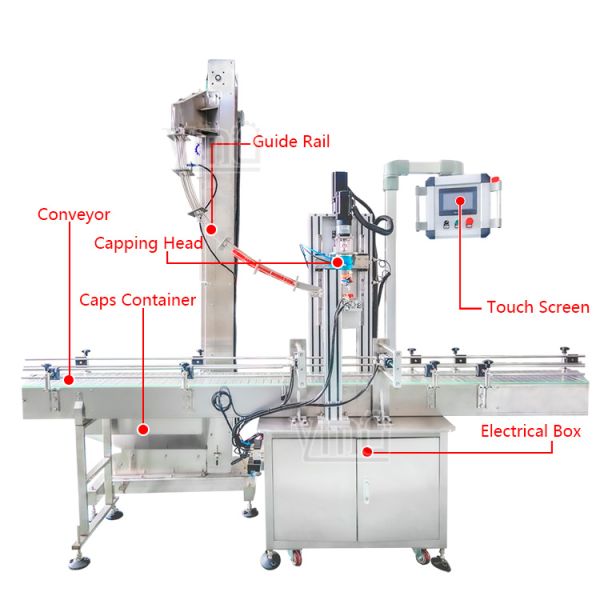
The CM100's servo-driven capping head replaces the pneumatic cylinder or mechanical clutch found in conventional cappers with a precision servo motor coupled to a torque sensor in a closed-loop feedback configuration:
| Parameter | Servo (CM100) | Pneumatic Capper | Mechanical Clutch |
|---|---|---|---|
| Torque Accuracy | ±0.5% of set point | ±15-25% (pressure-dependent) | ±10-20% (wear-dependent) |
| Adjustability | Digital set point on HMI, instant change | Manual regulator adjustment | Mechanical adjustment, requires tools |
| Repeatability | Identical every cycle | Varies with air pressure, seal wear | Drifts as clutch surfaces wear |
| Cap Damage Rate | <0.1% | 1-3% | 2-5% |
| Changeover Time | <90 seconds (recipe select) | 5-15 minutes (manual tune-in) | 10-20 minutes |
| Glass Bottle Cracking | Virtually eliminated | Occasional over-torque cracking | Occasional over-torque cracking |
| Maintenance Interval | 5,000+ hours | 500-1,000 hours (seal replacement) | 1,000-2,000 hours (clutch replacement) |
The financial impact of imprecise capping cascades through the supply chain:
Under-torqued caps leak in transit, contaminating secondary packaging, triggering retailer chargebacks ($150-500 per incident), and eroding consumer trust. One major beverage brand estimated that a 1% under-torque rate cost $2.4 million annually in product loss and chargebacks.
Over-torqued caps frustrate consumers, particularly elderly users or those with reduced hand strength. Consumer complaint data consistently ranks "cap too tight" among the top 5 reasons for negative product reviews. Damaged threads from over-torquing also create a leak path for the next use, even if the initial seal holds.
Inconsistent torque across a production run means some consumers struggle while others find their caps loose — an inconsistency that damages brand perception of quality control.
The CM100's servo torque control eliminates these problems at the source, delivering identical torque to every bottle in the run.
The CM100's touchscreen HMI provides:
Q: What is the torque range of the CM100?
A: The standard CM100 servo motor and gearbox configuration covers a torque range of approximately 0.5-30 N·m, suitable for caps from 20mm to 130mm diameter. For applications outside this range, the servo motor and gear reducer can be resized. Please provide your target torque specification for an accurate configuration recommendation.
Q: How often does the torque sensor need calibration?
A: We recommend annual torque sensor calibration as part of preventive maintenance, or more frequently in high-utilization (3-shift) operations. Calibration is performed using a calibrated torque transducer traceable to national standards. The calibration procedure is documented in the user manual and can be performed by your in-house metrology team or by our service engineers.
Q: Does the torque remain consistent as the servo motor ages?
A: Yes — this is a key advantage of closed-loop feedback control. The torque sensor measures actual applied torque, not motor current. As long as the sensor is within its calibration interval, the feedback loop compensates for any changes in motor efficiency, bearing friction, or mechanical wear. Torque at the cap is what the sensor measures and what the controller maintains.
Q: Who manufactures the servo motor used in the CM100?
A: The CM100 uses internationally recognized servo motor brands. The specific brand and model are specified in your quotation and are selected based on your regional service preferences and voltage requirements. All servo motors used are supported by local distributors for spare parts and service in major markets worldwide.
Q: Can your engineers help us determine the correct torque specification for a new product?
A: Yes. Our application engineering team provides torque development support as part of our pre-sales service. Send us your bottles, caps, and any seal liner or gasket material, and we will perform torque-to-failure testing and torque-to-seal testing to determine the optimal torque window. We provide a formal report with recommended set points and tolerances.
Q: What happens if the servo drive fails after the warranty period?
A: Servo drives from major manufacturers are widely available globally. We provide the exact part number and firmware version in your machine documentation so you can source locally if preferred. Alternatively, we stock replacement drives and can ship internationally within 3-7 business days. Our remote diagnostic service can often resolve servo-related issues through parameter adjustment without hardware replacement.
Q: Do you offer a torque validation service for existing lines considering an upgrade to servo capping?
A: Yes. If you are currently using pneumatic or mechanical clutch cappers and considering an upgrade, we can provide a torque audit — measuring the actual torque distribution on your current line across a statistically significant sample — and quantify the improvement a servo system would deliver. This data supports your capital expenditure justification.

|
 45Pcs/Min Automatic Bottle Capping Machine Servo Motor Screw Cap Feeder
CE Certificated Screw Semi Automatic Capping Machine Single Head 20BPM
Linear Plastic Glass Metal Automatic Capping Machine For Perfume Bottle High Speed 45BPM
Pneumatic Linear Screw Automatic Capping Machine For Metal Plastic Caps 1500W 110V
Touchscreen Bottle Screw Automatic Capping Machine For Plastic Bucket Lid OEM
Food Beverage Automatic Capping Machine Big Barrel Can Capper Sealer 304SUS
High Speed Auto Capping Machine Automatic Capper Feeding Systems 220V SS304
PLC Semi Auto Bottle Screw Capping Machine For Oil Drums Cans 220V
600kg Semi Automatic Capping Machine For Honey Juice pet Bottle Cap ODM
45Pcs/Min Automatic Bottle Capping Machine Servo Motor Screw Cap Feeder
CE Certificated Screw Semi Automatic Capping Machine Single Head 20BPM
Linear Plastic Glass Metal Automatic Capping Machine For Perfume Bottle High Speed 45BPM
Pneumatic Linear Screw Automatic Capping Machine For Metal Plastic Caps 1500W 110V
Touchscreen Bottle Screw Automatic Capping Machine For Plastic Bucket Lid OEM
Food Beverage Automatic Capping Machine Big Barrel Can Capper Sealer 304SUS
High Speed Auto Capping Machine Automatic Capper Feeding Systems 220V SS304
PLC Semi Auto Bottle Screw Capping Machine For Oil Drums Cans 220V
600kg Semi Automatic Capping Machine For Honey Juice pet Bottle Cap ODM

