| Sign In | Join Free | My infospaceinc.com |
|
| Sign In | Join Free | My infospaceinc.com |
|
| Categories | Automatic Capping Machine |
|---|---|
| Model Number: | CM100 |
| After-sales Service Provided: | Online Support Video Technical Support |
| MOQ: | 1 Set |
| Price: | $6299-$7799/1set |
| Product name: | One Head Screw Capping Machine |
| Applied cap diameter: | 20-130mm |
| MOQ: | 1 SET |
| Delivery Time: | 30 Work days |
| Application: | Flat Round Cap |
| Working speed: | 20-40bottle/min |
| Power: | 1500W, 110V/220V, 50/60Hz |
| Applied bottle width (diameter): | 50-300mm |
| Certification: | CE, SGS |
| Size: | 2500x1300x2500mm |
| Payment Terms: | L/C,D/A,D/P,T/T,Western Union |
| Weight: | 600kg |
| Applied bottle height: | 100-600mm |
| Advantage: | Easy Operation High Efficiency |
| Control: | PLC+ Touch Screen+Motor |
| Supply Ability: | 1000Sets / year |
| Function: | Capper Cap-locking Machine |
| Operation: | PLC+touch Screen |
| Brand Name: | YIMU |
| Bottle type: | Plastic Bottle Glass Bottle Cans |
| Usage: | Plastic Glass Metal Bottle Capping |
| Place of Origin: | Shanghai, China |
| Capping speed: | 20-45bottle/min |
| Packaging Details: | WOODEN CASE |
| Material: | Stainless Steel+aluminum |
| Company Info. |
| Shanghai Yimu Machinery Co., Ltd. |
| Verified Supplier |
| View Contact Details |
| Product List |
Automatic 1 Wheels High Speed Capping Machine Manufacturer Honey Jam Jars and Straw Cups Cap Capper Machine With Feeder Elevator
The cap feeding system is the unsung hero of any automatic capping machine. A sophisticated servo-driven capping head means nothing if caps do not arrive at the pickup point consistently, correctly oriented, and at the right pace. Cap feeding problems — jams, mis-oriented caps, inconsistent feed rate — are the most common cause of capping line downtime. Choosing the right feeding system for your cap type, production volume, and operating environment is therefore one of the most consequential decisions in specifying a capping machine.
The CM100 offers two cap feeding configurations: the cap elevator for higher-volume, larger-cap applications, and the vibrating disk feeder for smaller caps, specialty closures, or lower-volume lines. Both systems feed into a custom-fabricated SS304 cap track that delivers caps to the capping head pickup point with precision.

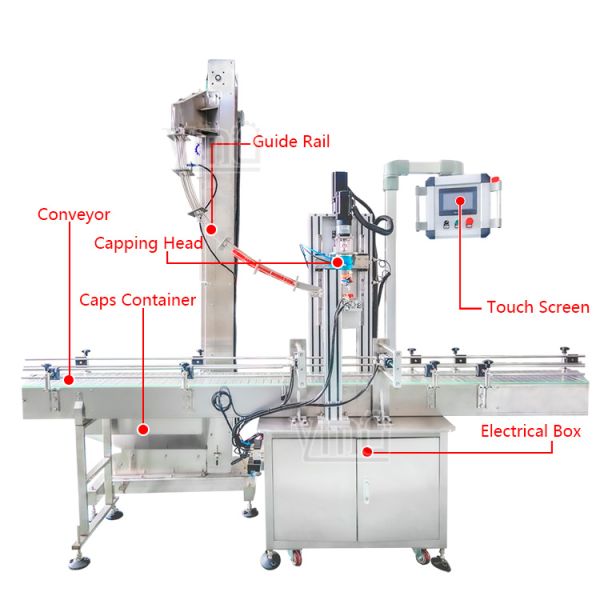

The cap elevator uses a cleated belt mechanism housed in a floor-standing unit adjacent to the CM100 mainframe. Bulk caps are loaded into a large-capacity hopper at the base of the elevator. As the belt rotates, cleats pick up individual caps and carry them upward. At the top of the elevator, correctly oriented caps are discharged onto the SS304 cap track, which gravity-feeds them toward the capping head pickup position. Mis-oriented caps fall back into the hopper for re-circulation.
Best for:
Advantages:
Limitations:
The vibrating disk feeder uses an electromagnetic vibration drive to move caps along a spiral track machined into a circular bowl. As caps vibrate up the spiral, orientation features (cutouts, air jets, wiper bars) ensure that only correctly oriented caps reach the discharge point. Incorrectly oriented caps fall back to the bowl center for re-circulation.
Best for:
Advantages:
Limitations:
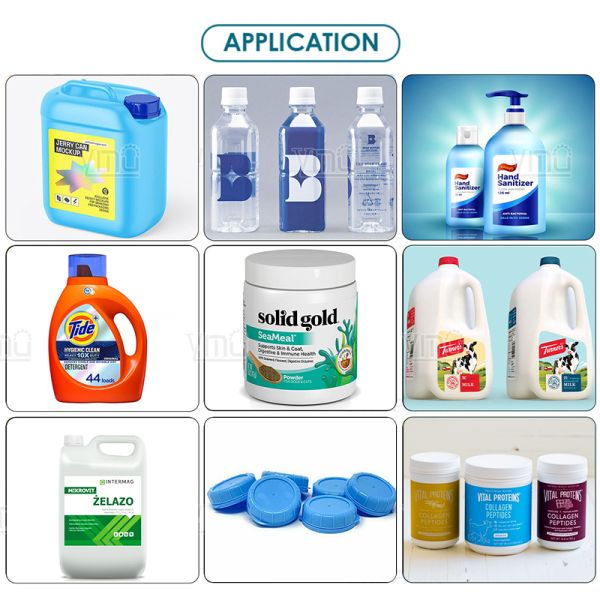
Regardless of which feeding system is selected, the cap track — the guided path from the feeder discharge to the capping head pickup point — is custom-fabricated for your specific cap dimensions and geometry. The track is constructed from SS304 stainless steel rods (for the guide rails) and 3mm-thick SS304 plate (for the track bed). Key design features:
For operations running multiple cap types on the same line, the CM100 can be configured with both feeding systems — the cap elevator for primary production and the vibrating disk for specialty or low-volume SKUs. The operator selects which feeder is active from the HMI, and the cap track gating routes caps from the selected feeder to the pickup point.
| If Your Caps Are... | And Your Volume Is... | Recommended Feeder |
|---|---|---|
| Large (40mm+), simple geometry | >1,500 bottles/hour | Cap Elevator |
| Large (40mm+), simple geometry | <1,500 bottles/hour | Either (cost decision) |
| Small (<40mm), any geometry | Any volume | Vibrating Disk |
| Decorative/fragile surface finish | Any volume | Vibrating Disk |
| Wide range of cap sizes on one line | Any volume | Elevator + Vibrating Disk |
Q: Can the cap feeding system handle caps that are wet or have residual product on them?
A: The cap track is designed with open construction that allows moisture to drain. However, caps should ideally be dry when loaded into the feeding system. Wet caps can cause bridging in the hopper and reduced friction on the cleated belt of the elevator. If your process results in wet caps (e.g., from an upstream washing step), we recommend adding a cap drying station before the feeder.
Q: How long does it take to switch between two different cap sizes?
A: For caps that share the same feeding system and have relatively similar dimensions, the changeover involves swapping the cap track guide rails and the capping head insert — typically 10-15 minutes. If switching between the cap elevator and vibrating disk feeder, the changeover (including track reconfiguration) takes approximately 20-30 minutes.
Q: What happens if a cap jams in the track?
A: A cap presence sensor at the pickup point detects if a cap has not arrived within the expected time window. The machine pauses the capping cycle and displays a "Cap Feed Fault" alarm on the HMI. The operator clears the jam (usually a 30-second operation), acknowledges the alarm, and the machine resumes automatically.
Q: Can the vibrating disk feeder be tuned for different cap weights?
A: Yes. The vibration amplitude and frequency are adjustable via the HMI or a dedicated control box on the feeder. For operations regularly switching between significantly different cap types (e.g., lightweight 28mm beverage caps and heavy 110mm industrial caps), we pre-configure vibration settings for each cap type and save them in the recipe database.
Q: Do you design the cap track in-house?
A: Yes. Our engineering team designs and fabricates all cap tracks in our Shanghai facility based on your cap samples and 3D measurements. This ensures a perfect fit for your specific cap geometry rather than relying on generic "close enough" track dimensions.
Q: What cap information do you need to design the feeding system?
A: We need cap samples (at least 20 pieces for measurement averaging), cap material (PP, PE, metal, etc.), cap diameter and height, any special orientation features (directional spout, dip tube, etc.), and your target throughput. If sending physical samples internationally is impractical, we can work from detailed dimensional drawings and high-resolution photographs.
Q: Can you retrofit a different feeding system to an existing CM100?
A: Yes. The CM100 is designed with a modular feeding system interface. If your production needs change — for example, you add a SKU with trigger sprayer caps that your original cap elevator configuration cannot handle — we can supply and install a vibrating disk feeder module that integrates with the existing control system and cap track.
Q: What spare parts should I stock for the cap feeding system?
A: We recommend stocking: one set of cap track guide rails (wear items), one set of cleats for the elevator belt (if using cap elevator), and one set of vibration isolators/mounts (if using vibrating disk). These are low-cost items that prevent extended downtime from a simple wear-part failure.

|
 45Pcs/Min Automatic Bottle Capping Machine Servo Motor Screw Cap Feeder
CE Certificated Screw Semi Automatic Capping Machine Single Head 20BPM
Linear Plastic Glass Metal Automatic Capping Machine For Perfume Bottle High Speed 45BPM
Pneumatic Linear Screw Automatic Capping Machine For Metal Plastic Caps 1500W 110V
Touchscreen Bottle Screw Automatic Capping Machine For Plastic Bucket Lid OEM
Food Beverage Automatic Capping Machine Big Barrel Can Capper Sealer 304SUS
PLC Semi Auto Bottle Screw Capping Machine For Oil Drums Cans 220V
Full Automatic Jar Capping Machine Single Head Plastic Glass Metal Bottle Cap Equipment
600kg Semi Automatic Capping Machine For Honey Juice pet Bottle Cap ODM
45Pcs/Min Automatic Bottle Capping Machine Servo Motor Screw Cap Feeder
CE Certificated Screw Semi Automatic Capping Machine Single Head 20BPM
Linear Plastic Glass Metal Automatic Capping Machine For Perfume Bottle High Speed 45BPM
Pneumatic Linear Screw Automatic Capping Machine For Metal Plastic Caps 1500W 110V
Touchscreen Bottle Screw Automatic Capping Machine For Plastic Bucket Lid OEM
Food Beverage Automatic Capping Machine Big Barrel Can Capper Sealer 304SUS
PLC Semi Auto Bottle Screw Capping Machine For Oil Drums Cans 220V
Full Automatic Jar Capping Machine Single Head Plastic Glass Metal Bottle Cap Equipment
600kg Semi Automatic Capping Machine For Honey Juice pet Bottle Cap ODM

