| Sign In | Join Free | My infospaceinc.com |
|
| Sign In | Join Free | My infospaceinc.com |
|
| Categories | Single Layer Capacitor |
|---|---|
| Equivalent Series Resistance (ESR): | <0.1 Ω @ 1 GHz |
| Gate Length: | 1 µm |
| Dielectric Material Type: | Class I (COG/NPO) / Class II (X7R) |
| Substrate Type: | P-type Silicon |
| Place of Origin: | china |
| Brand Name: | Hoan |
| MOQ: | 10 |
| Temperature Range: | -40 to 125 °C |
| Payment Terms: | L/C,D/P,D/A,T/T, |
| Wire Bond Pull Strength: | >3.0 grams (meets MIL-STD-883) |
| Dielectric Withstanding Voltage (DWV): | 250% of Rated Voltage (100V → 250V) |
| Model Number: | HACC100S10V101 |
| Company Info. |
| HongAn Microwave Co., Ltd. |
| Verified Supplier |
| View Contact Details |
| Product List |
HACC100S10V101 Bordered Single Layer Ceramic Chip Capacitor (10pF,100V)
What is a Single-Sided Bordered (Margin) Single Layer Capacitor?
In high-density microwave hybrid integrated circuits (ICs), engineers face a common assembly challenge: during die attachment, conductive silver epoxy (such as H20E) can bleed out, creep up the sides of the chip capacitor, and bridge with the top electrode, causing a catastrophic short circuit.
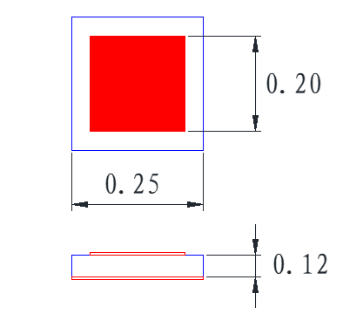
The HACC100S10V101 resolves this with its Single-Sided Bordered (Margin) Design. As shown in the product image, the top surface consists of a central high-purity gold electrode (TiW-Au) surrounded by a precise, un-metallized dark ceramic border (Margin). This exposed ceramic frame acts as a physical barrier, effectively blocking any epoxy bleed-out from contacting the active top electrode, guaranteeing zero-defect bonding during automated assembly.
Material & Thin-Film Metallization Structure
The HACC100S10V101 features a premium, multi-layer thin-film
metallization system to ensure long-term reliability under severe
thermal and mechanical stresses:
•Top Electrode: TiW-Au (Titanium-Tungsten / Gold) with an overall gold thickness
of ≥ 2.5 µm Min. This thick, high-purity gold layer is optimized for
high-reliability thermosonic gold wire bonding (Au wire-bonding).
•Bottom Electrode: TiW-Pt-Au (Titanium-Tungsten / Platinum / Gold) with an overall
thickness of ≥ 2.5 µm Min. The inclusion of a Platinum (Pt) barrier layer
prevents silver-to-gold intermetallic migration when using silver
conductive epoxies, ensuring maximum adhesion.
Dimensions
Technical Specifications (HACC100S10V101)
| Technical Parameter | Specification Value | Test/Environmental Conditions |
| Part Number | HACC100S10V101 | |
| Capacitor Style | Single Layer Ceramic Chip(SLC) | Single-sided bordered (Margin) type |
| Capacitance | 10 pF±10% | Measured @ 1kHz, 1Vrms, 25°C, No DCBias |
| Rated Voltage | 100VDC | High-voltage reliability margin |
| Operating Temp. Range | -55°Cto +125°C | Fully complies with Tactical-gradestandards |
| Top Metallization System | TiW-Au (Au > 2.5 um Min) | Solderable & Wire-bondable |
| Bottom MetallizationSystem | TiW-Pt-Au (Au > 2.5 um Min) | Excellent conductive epoxy compatibility |
| Frequency Capability | Optimized for GHz Band | Ultra-low ESR and ESL at microwave bands |
Assembly & Gold Wire Bonding Best Practices
To achieve an optimal assembly yield when integrating the HACC100S10V101 into your RF modules:
1.Conductive Epoxy Die-Attach:
•Mounting with conductive silver epoxy (e.g., H20E) is highly
recommended.
•Recommended Baking/Curing Profile: Bake at 120℃ for 30 minutes to
ensure robust mechanical and electrical attachment.
2.Gold Wire Bonding Wedge Margin:
•To prevent micro-cracking of the ceramic or delamination of the
gold film during thermosonic wire-bonding, the bonding ball/wedge
must be placed at least 25 µm away from the outer edge of the gold
pad.
3.Die Placement Force:
•Keep the pick-and-place nozzle force controlled to prevent
localized stress on the single-layer ceramic body.
Typical High-Frequency Microwave Applications
•5G & 6G Millimeter-Wave (mmWave) Small Cells
•Optoelectronic Transceivers (100G/400G SFP/QSFP Modules)
•GaAs, GaN & InP High-Power RF Amplifiers (Bypass & Decoupling)
•LNA (Low Noise Amplifier) DC Blocking Circuits
•Satellite Communications (Satcom) and Tactical Avionics

|
 22pF 50V Bordered Single Layer Capacitor Platinum Barrier Capacitor For High Frequency
Thin Film Single Layer Capacitor 470pF 50V 0.05GHz - 25GHz Broadband Capacitor
Double Sided Bordered Single Layer Capacitor 100pF 50V Low ESR Capacitor
100pF 100V Single Layer Capacitor Double Sided Bordered Broadband Capacitor 0.05GHz - 15GHz
100V 100pF Broadband Capacitor 0.1GHz - 20GHz Low ESR Capacitor Double Sided Bordered Thin Film
High K Dielectric Single Layer Capacitor 1000pF 50V DC Block Capacitor Epoxy Protection
1000pF 35V MOS Capacitor SiO2 Dielectric Gold Metal Low ESR Capacitor For RF IC
470pF 20V MOS Capacitor SiO2 Dielectric Low Leakage Capacitor For RF Circuits
330pF 16V Broadband Capacitor 0.1GHz - 30GHz Bordered Low ESR Capacitor Gold Bond Pad
100pF 50V Broadband Capacitor 0.4GHz - 40GHz Low ESR Capacitor Gold Wire Bonding
22pF 50V Bordered Single Layer Capacitor Platinum Barrier Capacitor For High Frequency
Thin Film Single Layer Capacitor 470pF 50V 0.05GHz - 25GHz Broadband Capacitor
Double Sided Bordered Single Layer Capacitor 100pF 50V Low ESR Capacitor
100pF 100V Single Layer Capacitor Double Sided Bordered Broadband Capacitor 0.05GHz - 15GHz
100V 100pF Broadband Capacitor 0.1GHz - 20GHz Low ESR Capacitor Double Sided Bordered Thin Film
High K Dielectric Single Layer Capacitor 1000pF 50V DC Block Capacitor Epoxy Protection
1000pF 35V MOS Capacitor SiO2 Dielectric Gold Metal Low ESR Capacitor For RF IC
470pF 20V MOS Capacitor SiO2 Dielectric Low Leakage Capacitor For RF Circuits
330pF 16V Broadband Capacitor 0.1GHz - 30GHz Bordered Low ESR Capacitor Gold Bond Pad
100pF 50V Broadband Capacitor 0.4GHz - 40GHz Low ESR Capacitor Gold Wire Bonding

