Phosphor bronze, a unique alloy composed primarily of copper with
the addition of phosphorus and other elements, is renowned for its
excellent mechanical properties, corrosion resistance, and wear
resistance. When combined with graphite, phosphor bronze creates a
material that offers superior lubrication and reduced friction,
making it ideal for use in bushings and bearings.
Graphite plugged bushings, specifically made from phosphor bronze,
provide a robust and long-lasting solution for various industrial
applications. The graphite plugs act as solid lubricants, ensuring
smooth and efficient operation even in high-temperature or
high-pressure environments. This combination of phosphor bronze and
graphite offers exceptional wear resistance and durability,
extending the lifespan of the bushings significantly.
Cast bronze bearings made from phosphor bronze material exhibit
similar characteristics, providing reliable performance and reduced
maintenance requirements. The material's corrosion resistance
ensures that the bearings can withstand harsh environments and
maintain their integrity over time.
In summary, phosphor bronze graphite plugged bushings and cast
bronze bearings are excellent choices for industrial applications
where durability, wear resistance, and smooth operation are
critical. The unique properties of phosphor bronze, combined with
the lubrication provided by graphite, make these components ideal
for a wide range of mechanical systems and devices.
Phosphor Bronze Graphite Plugged Bushings Cast Bronze Bearings
Material, 65x55x40 graffito bearing bushing buje de bronce grafito
C51000 vs. C54400 Phosphor Bronze for Bushings
C51000 and C54400 are both copper-based phosphor bronze alloys
valued for their corrosion resistance, strength, and wear
properties—making them common choices for bushings. While they
share many characteristics, their compositions and properties make
them suitable for different applications.
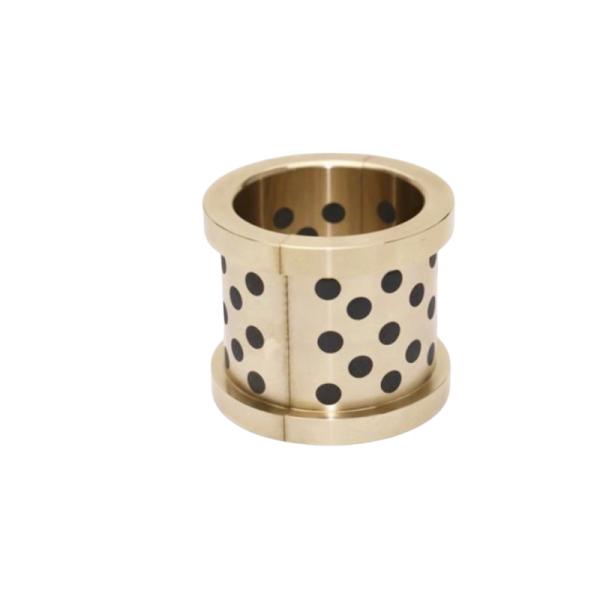
C51000 is a tin–phosphor bronze known for high ductility, good strength,
and fine grain structure. It is versatile, used in springs,
electrical connectors, and bushings that require resistance to
deformation.
C54400 is a free-cutting phosphor bronze containing lead and zinc, which
significantly improve machinability and bearing performance, making
it ideal for precision bushings and heavy-duty bearings.
Chemical Composition
Key differences lie in lead and zinc content, which enhance
machinability and wear resistance in C54400, while C51000 remains
lead-free with higher copper content for better electrical
conductivity.
| Element | C51000 (%) | C54400 (%) |
|---|
| Copper (Cu) | 92.9 – 95.5 | 85.4 – 91.5 |
| Tin (Sn) | 4.5 – 5.8 | 3.5 – 4.5 |
| Phosphorus (P) | 0.03 – 0.35 | 0.01 – 0.5 |
| Lead (Pb) | 0 – 0.05 | 3.5 – 4.5 |
| Zinc (Zn) | 0 – 0.3 | 1.5 – 4.5 |
| Iron (Fe) | 0 – 0.1 | 0 – 0.1 |
| Residuals | — | 0 – 0.5 |
Mechanical Properties
Both alloys offer good strength and elasticity. C54400 is far
easier to machine (machinability rating 80 vs. 20) and excels in
producing complex or high-volume bushings. C51000 provides better
ductility for applications requiring flexibility.
| Property | C51000 | C54400 |
|---|
| Tensile Strength (MPa) | 324 – 965 | 303 – 517 |
| Yield Strength (MPa) | 131 – 552 | 131 – 434 |
| Elongation (%) | 6 – 45 | 0 – 50 |
| Shear Modulus (GPa) | 41 – 42 | 39 – 40 |
| Elastic Modulus (GPa) | 110 – 117 | 110 – 117 |
| Poisson's Ratio | 0.34 | 0.34 |
| Machinability (100 = best) | 20 | 80 |
| Rockwell B Hardness | 26 – 97 | 67 – 93 |
Thermal & Electrical Properties
Values are broadly similar, with C54400 offering slightly higher
thermal conductivity for better heat dissipation in high-load
bushings.
| Property | C51000 | C54400 |
|---|
| Thermal Conductivity (W/m·K) | 77 – 84 | 86 – 87 |
| Thermal Expansion (µm/m·K) | 17.8 – 18 | 17.3 – 18 |
| Specific Heat (J/kg·K) | 380 | 370 |
| Melting Onset (°C) | 960 | 930 |
| Electrical Conductivity (% IACS) | 15 – 18 | 19 |

Applications in Bushings
Both alloys are well-suited for bushings thanks to their wear
resistance, low friction, and corrosion resistance in marine,
industrial, or general environments.
C51000: Ideal for sleeve bushings, clutch discs, and applications needing
good ductility and spring-like qualities. Also used in electrical
connectors, welding rods, and perforated sheets. Fine grain
structure provides toughness and fatigue resistance.
C54400: Preferred for high-wear bearings, gears, shafts, and thrust
washers. Lead improves machinability and bearing properties, making
it excellent for precision parts like valve components and cam
followers. Zinc and lead make it a free-cutting alloy, well-suited
for custom bushings.
Key Differences for Bushing Selection
Machinability – C54400 machines far more easily (80 vs. 20 rating).
Wear Resistance – C54400 is optimized for demanding bearing/bushing environments;
C51000 is more general-purpose.
Corrosion & Conductivity – Both resist corrosion, but C51000 offers higher copper content
for better electrical performance.
Environmental Compliance – C51000 is lead-free, while C54400 contains lead, which may be
restricted under RoHS or similar regulations.
Form & Availability – C51000 is common in wrought forms; C54400 is popular for cast or
machined components.
Selection Tip:
For heavy-load, high-wear, or precision bushings → choose C54400.
For lighter-duty, ductility-focused, or lead-free applications → choose C51000.
Plug graphite bearings are primarily used in applications that need
continual lubrication in hard to reach areas. Graphite is
mechanically forced into the holes/grooves under extreme pressure.
A film of lubricant is transferred to the shaft as it begins to
turn. These bearings offer continuous lubrication over long periods
without maintenance.
Introduction
1.The solid bronze/iron material is ideally suited for highly
demanding applications in tough environments. We offer a standard
assortment of plain sleeve bushings, flanged bushings and sliding plates in accordance with ISO 4379 and DIN1850.
2.The solid bronze body can be drilled holes and filled solid
graphite lubricant, in this way it can be used in oilless
environments.
3.Also the solid bronze body can be machined oil grooves and holes,
it can get better lubricating after filled with grease.
Features and advantages
1.Insensitive to dirty environment
2.Resistant to shock loads and vibrations at slow speeds
3.Enable operation with a poor shaft surface finish
4.Good resistance to corrosive conditions

Material
Phosphor bronze, also known as phosphorus bronze or tin phosphorus
bronze, is an alloy material composed primarily of copper, tin, and
phosphorus. It is a type of copper alloy that exhibits excellent
mechanical properties and electrical conductivity.
The composition of phosphor bronze typically includes the following
elements:
1.Copper (Cu): The main component of phosphor bronze, accounting
for the majority of its weight. Copper contributes to the alloy's
electrical conductivity, ductility, and corrosion resistance.
2.Tin (Sn): Added to the alloy in a range of 2% to 8% by weight.
Tin improves the strength and hardness of the material, as well as
its corrosion resistance.
3.Phosphorus (P): Present in a small amount, typically ranging from
0.03% to 0.35% by weight. Phosphorus acts as a deoxidizer and can
improve the mechanical properties of the alloy, such as its
toughness, elasticity, wear resistance, and corrosion resistance.
In addition to these primary elements, phosphor bronze may also
contain trace amounts of other elements like iron (Fe) and zinc
(Zn), which can further enhance its properties. The exact
composition of phosphor bronze can vary depending on the specific
alloy grade and manufacturer.
Due to its excellent combination of mechanical properties,
electrical conductivity, and corrosion resistance, phosphor bronze
is widely used in various industrial applications. It is commonly
employed in the manufacture of mechanical parts, electrical
components, and heat exchangers.
Solid Bronze bushings and plates are made completely of tin bronze,
CuSn10P, which has very good machine ability. All surfaces of the solid
bronze bushings are machined.
Solid iron bushings and plates are made in same way of bronze
material, but it is much lower costs if you are not in high
performance requirements.
Examples of applications
1.Construction machinery
2.Transport equipment
3.Pulp and papermaking machinery
4.Off-shore equipment
- Cylindrical product: bushings, bearings, bronze bearings
- Flat product: slide plates, guide bushing
- Continuous casting centrifugal casting,Bronze Plugged Graphite
Bearings Cast Bronze Bearings Material made to order online.It is
based on high strength copper alloy of special techniques. The
solid lubricant is inlayed by certain angle, density and special
formula, and then is processed exactly. The product is widely
applied to casting machine, mining machinery, shipping, steam
turbine, Injection machinery and automobile mounding, etc.
| Material Compostion and Properties |
| Code | BRONZE PARTS | BRONZE PARTS | BRONZE PARTS | BRONZE PARTS | BRONZE PARTS | BRONZE PARTS | BRONZE PARTS |
| (500#) | (500#S1) | (500#S2) | (500#S3) | (500#S4) | (HT250) | (Gcr15) |
| Code | CuZn25Al | CuZn25Al | CuAl9Fe4 | CuSn5P | CuSn12 | HT250 | Gcr15 |
| 5Mn3Fe3 | 5Mn3Fe3 | Ni4Mn2 | b5Zn5 |
| Density | 8 | 8 | 8.5 | 8.9 | 9.05 | 7.3 | 7.8 |
| Hardness HB | >210 | >250 | >150 | >70 | >80 | >190 | HRC>58 |
| N/mm2 Tensile strength | >750 | >800 | >800 | >200 | >260 | >250 | >1500 |
| Elongation% | >12 | >8 | >15 | >10 | >8 | >5 | >15 |
| Coefficien of linear expansion 10-5/℃ | 1.9 | 1.9 | 1.9 | 1.8 | 1.8 | 1 | 1.1 |
| Limit Temp ℃ | -40~+300 | -40~+150 | -40~+400 | -40~+400 | -40~+400 | -40~+400 | -40~+400 |
| Max.load N/mm2 | 100 | 120 | 150 | 60 | 70 | 80 | 200 |
| m/min Max.speed (Dry) | 15 | 15 | 20 | 10 | 10 | 8 | 5 |
| Max.PVN/mm2 *m/min | 200 | 200 | 60 | 60 | 80 | 40 | 150 |
| 300N/mm2 | <0.01 | <0.005 | <0.04 | <0.05 | <0.05 | <0.015 | <0.002 |
|
| Base Material International |
| Material Codes | China Brands GB1176-87 | Intenational ISO 1338 | Germany DIN | Japan JIS | America ASTM(UNS) | England BS | France NF |
| BRONZE PARTS(500#) | ZCuZn25Al6 Fe3Mn3 | GCuZn25Al6 Fe3Mn3 | DIN1709 G-CuZn25Al5 | H5102 CAC304 | B30-92 C86300 | HTB2 | |
| BRONZE PARTS(500#S1) | ZCuZn25Al6 Fe3Mn3 | GCuZn25Al6 Fe3Mn3 | DIN1709 G-CuZn25Al5 | H5102 CAC304 | B30-92 C86300 | HTB2 | |
| BRONZE PARTS(500#S2) | ZCuSn5 Pb5Zn5 | GCuPb5 Sn5Zn5 | DIN1705 G-CuSn5ZnPb | H5111 BC6 | B30-92 C83600 | LG2 | CuPb5 Sn5Zn5 |
| BRONZE PARTS(500#S3) | ZCuAl9Fe4 Ni4Mn2 | GCuAl10 FeNi5 | DIN17656 G-CuAl10Ni | H5114 AlBC3 | B30-92 C95500 | AB2 | CuAl10 Fe5Ni5 |
| BRONZE PARTS(HT250) | GB5675-85 HT250 | | | FC250 | ASTM Class40 | | |
| Solid Lubricant |
| Lubricant | Features | Typical application | | | | | |
| Graphite+add | Excellent resistance against chemical attacks and low friction,
Temp limit 400℃ | Suit for general machines and under atmosphere | | | | | |
| Type | Spec | Type | Spec | | |
| BRONZE GRAPHITE BUSHING | 808 | 8×12×8 | BRONZE GRAPHITE BUSHING | 1640 | 16×22×40 |
| BRONZE GRAPHITE BUSHING | 810 | 8×12×10 | BRONZE GRAPHITE BUSHING | 1812 | 18×24×12 |
| BRONZE GRAPHITE BUSHING | 812 | 8×12×12 | BRONZE GRAPHITE BUSHING | 1815 | 18×24×15 |
| BRONZE GRAPHITE BUSHING | 815 | 8×12×15 | BRONZE GRAPHITE BUSHING | 1820 | 18×24×20 |
| BRONZE GRAPHITE BUSHING | 1008 | 10×14×8 | BRONZE GRAPHITE BUSHING | 1825 | 18×24×25 |
| BRONZE GRAPHITE BUSHING | 1010 | 10×14×10 | BRONZE GRAPHITE BUSHING | 1830 | 18×24×30 |
| BRONZE GRAPHITE BUSHING | 1012 | 10×14×12 | BRONZE GRAPHITE BUSHING | 2010 | 20×28×10 |
| BRONZE GRAPHITE BUSHING | 1015 | 10×14×15 | BRONZE GRAPHITE BUSHING | 2012 | 20×28×12 |
| BRONZE GRAPHITE BUSHING | 1020 | 10×14×20 | BRONZE GRAPHITE BUSHING | 2016 | 20×28×16 |
| BRONZE GRAPHITE BUSHING | 1208 | 12×18×8 | BRONZE GRAPHITE BUSHING | 2019 | 20×28×19 |
| BRONZE GRAPHITE BUSHING | 1210 | 12×18×10 | BRONZE GRAPHITE BUSHING | 2020 | 20×28×20 |
| BRONZE GRAPHITE BUSHING | 1212 | 12×18×12 | BRONZE GRAPHITE BUSHING | 2025 | 20×28×25 |
| BRONZE GRAPHITE BUSHING | 1215 | 12×18×15 | BRONZE GRAPHITE BUSHING | 2030 | 20×28×30 |
| BRONZE GRAPHITE BUSHING | 1216 | 12×18×16 | BRONZE GRAPHITE BUSHING | 2035 | 20×28×35 |
| BRONZE GRAPHITE BUSHING | 1219 | 12×18×19 | BRONZE GRAPHITE BUSHING | 2040 | 20×28×40 |
| BRONZE GRAPHITE BUSHING | 1220 | 12×18×20 | BRONZE GRAPHITE BUSHING | 2050 | 20×28×50 |
| BRONZE GRAPHITE BUSHING | 1225 | 12×18×25 | BRONZE GRAPHITE BUSHING | 2512 | 25×33×12 |
| BRONZE GRAPHITE BUSHING | 1230 | 12×18×30 | BRONZE GRAPHITE BUSHING | 2516 | 25×33×16 |
| BRONZE GRAPHITE BUSHING | 1310 | 13×19×10 | BRONZE GRAPHITE BUSHING | 2520 | 25×33×20 |
| BRONZE GRAPHITE BUSHING | 1312 | 13×19×12 | BRONZE GRAPHITE BUSHING | 2525 | 25×33×25 |
| BRONZE GRAPHITE BUSHING | 1315 | 13×19×15 | BRONZE GRAPHITE BUSHING | 2530 | 25×33×30 |
| BRONZE GRAPHITE BUSHING | 1320 | 13×19×20 | BRONZE GRAPHITE BUSHING | 2535 | 25×33×35 |
| BRONZE GRAPHITE BUSHING | 1410 | 14×20×10 | BRONZE GRAPHITE BUSHING | 2540 | 25×33×40 |

Specifications:
| Material | Bronze | CuZn25Al6Fe3Mn3 + Graphite |
| Iron | Cast-iron + Graphite |
| Density | | 8.2g/cm3 |
| Tensile Strength | | >=755N/mm2 |
| Anti-compact Tenacity | | >=400~500KJ/m3 |
| Hardness | | >=200HB |
| Max Load Pressure | | 100N/mm2 |
| Speed Limit | | 0.5m/s |
| PV value limit | | 1.65N/mm2.m/s |
| Friction coef | Oil Lubrication | 0.03 |
| Dry Friction | 0.16 |
| Working temperature | | -40~+300°C |
https://www.bronzelube.com


