| Sign In | Join Free | My infospaceinc.com |
|
| Sign In | Join Free | My infospaceinc.com |
|
| Categories | Bronze Gleitlager |
|---|---|
| Brand Name: | VIIPLUS |
| Model Number: | GLIDLAGER |
| Certification: | Metric size and inch size bushing |
| Place of Origin: | gleitlagerbuchsen china |
| MOQ: | negotiable |
| Price: | Negotiable |
| Payment Terms: | T/T |
| Supply Ability: | bronze sleeve bushings, China, manufacturers, suppliers, factory, wholesale, Metallic Self Lubricating Bushings, Cast Iron Bearing, Sleeve Bushing, POM Bearing, Cast Iron Plain Bearing, Lubrication Bronze Bushing |
| Delivery Time: | 7-15 work days |
| Packaging Details: | EXPORT CARTON WOOD PALLET WOODEN CASE |
| Material: | Stainless Steel Bushing |
| Type: | Bushes |
| Bushing: | Metric Size GLIDLAGER 110X115X60MM |
| Dimension: | Customized Dimension Bushings |
| Get A Better Quote: | tiffany@viiplus.com |
| Self-lubricating Bearing Bushing Manufacturer: | https://www.viiplus.com/ |
| High Light:: | Slit Oilless Bronze Bushing, Anti Fatigue Oilless Bronze Bushing, Maintenance Free Oilless Bronze Bushing |
| Gleitalger: | A plain bearing, or more commonly sliding contact bearing and slide bearing, is the simplest type of bearing, comprising just a bearing surface and no rolling elements. Therefore, the journal slides over the bearing surface. The simplest example of a plain |
| Bush Bearings Manufacturers Suppliers Exporters: | plain bearings. Long, maintenance-free service, manufactures bushings in various designs and from different materials. tiffany@viiplus.com, Bushings - Configure and purchase - https://www.viiplus.com/ |
STANDARD SIZES Special sizes and materials are available on request
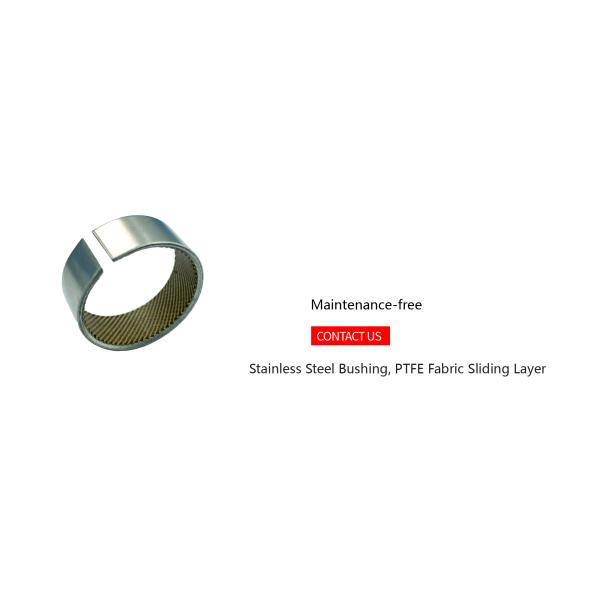
Stainless Steel Bushing bearing material is a self-lubricating, resin-impregnated hybrid cloth with fibers on the wear surface, bonded onto 316 stainless steel or Inconel 625 with special high-temperature adhesive. It has been developed for use as a low friction liner for valve stem bearings, particularly in high-temperature applications such as steam and process chemicals.
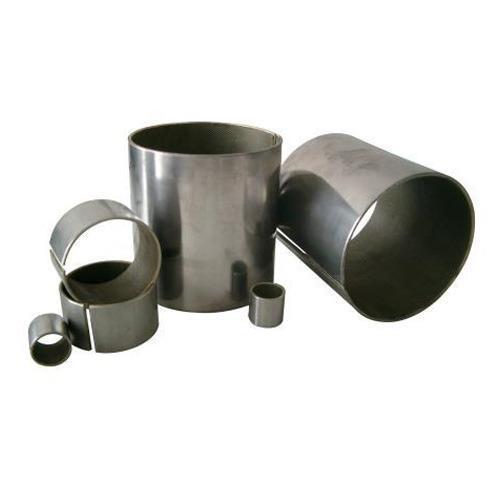
Self-lubricating bearings bushing are available in a range of
shapes and sizes
bearings are low friction, self-lubricating, and have high load
carrying capabilities. They are made up of a woven layer bonded to a metal support. The metal backing is chosen to be
suitable for the application and is usually chosen from mild steel,
zinc plated mild steel, stainless steel, Inconel, brass or bronze.
Applications Self-lubricating bearings are used to allow movement between mating surfaces in many different industries,
for example Valves: Self-lubricating bearings are used in all types of valves and are typically used for trunnion bearings and stem guides. Hydropower plants: Self-lubricating bearings are ideally suited for turbine guide vane assemblies and their actuators accomodating the high surface pressures involved. Agricultural machinery: In farm tractor kingpin, rocker shaft, and hitch assemblies. Crane and lifting equipment: Crane and hoist manufacturers use Self-lubricating bearings' ability to handle very high loads in boom foot pivots, and hinge and brace points in the mast pendant assembly which are inaccessible for grease lubrication. Self-lubricating bearings are completely self-lubricating and normally run dry, however, they can also be used where lubricating or other fluids are present. In dry operation, Self-lubricating bearings are recommended where low surface speeds are combined with high loads (see Technical Manual).
Features and Benefits
woven layer bearings: Are self-lubricating and operate without external lubrication. ? Are free from stick-slip, giving easy movement and operation. ? Are composite in nature and do not have the cold flow tendencies of solid and filled resins. ? Have high wear resistance giving long life. ? Can operate at temperatures beyond the range of most lubricants -50C to +150C. ? Are corrosion-resistant so can be used with aggressive liquids such as seawater, gasoline, acids, detergent solutions, hydraulic oils, ammonium hydroxide, oils. ? Are strong and can carry loads up to 420 N/mm2 for stainless steel and Inconel. ? Have good dimensional stability and the capacity to be formed to close tolerances.
When bonded to steel. Materials retain the ability to form and to a
large extent have a high load capacity.
It is composed of polytetrafluoroethylene composite, blanking
copper mesh, and steel back. The material structure has the bearing
characteristics of polytetrafluoroethylene compound base tape and
the shaping ability of punching cut metal mesh.
Bushing and pin shaft can be used with an interference fit to
produce a wall thickness of 1 mm or thicker bearing, and at the
same time achieve interference fit in the housing. Various methods
can be used to protect the steel case from corrosion.
Availability
Standard packing is made of lubricating graphite, and other fillers
may be added as required. The bushing style can be gasket type,
straight sleeve type, flange type, and deep drawing type.
Construction
woven layer bearing is a propriety self-lubricating bearing material of woven fibers applied to a rigid backing. To assure the best possible bond between the fibers and backing material, a secondary more readily bondable fibre is interwoven with the fibres so that is predominantly presented on the side of the bearing of the fabric.
woven layer bearings have the ability to resist cold flow under extremely high loads because the monofilament fibers have a tensile strength approximately 15 times greater than straight resins. Cold flow is also minimized by the effective entrapment of the fiber bundles by the high strength bonding resins.
woven layer bearings: The metal backing is chosen to be suitable for the application and is usually chosen from mild steel, zinc plated mild steel, stainless steel, Inconel, brass or bronze.
The fabric is embedded in artificial resin and securely bonded to the support
body. The material will not expand and is chemically resistant to
most media. It is especially suitable for oscillating motion, but
can also be used for rotational or linear motion.
Stainless Steel Bushing, Fabric Sliding Layer can support heavy loads and dissipate heat well. The
steel body allows easy and secure installation even at high temperatures or in light-metal housings. They have good sliding characteristics and a low coefficient of friction.
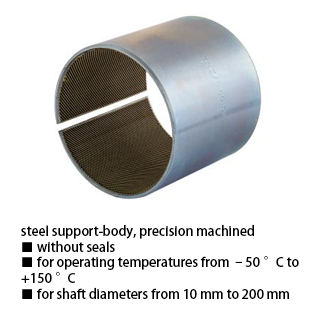
Hardened steel, chrome-plated materials 45-50 HRC, surface finish
<0.8 Ra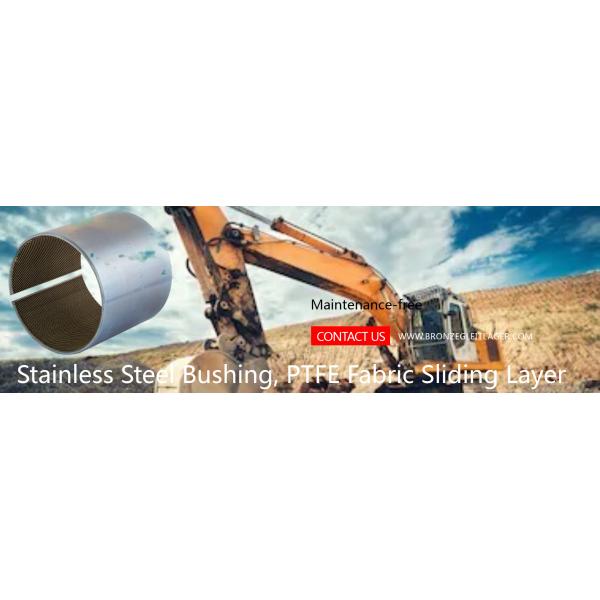
Stainless Steel Bushing, Fabric Sliding Layer has very good sliding abilities with a low friction value. No stick-slip effect and no moisture expansion. very good wear resistance.
– The support body allows for easy handling and secure installation.
– The fabric is embedded in artificial resin and securely bonded to the support
body. The adhesive bonding is resistant to moisture and will not
expand.
– The load limit for Stainless Steel Bushing, Fabric Sliding Layer is determined by the strength of the support
body and by the sliding layer
– Plastic injection machines: elbow lever bearing support
– Cranes: articulating arm and cylinder bearing support
– Loaders: boom and cylinder bearing support
– Commercial vehicles: hydraulic platform bearing
– Textile and printing machines: conveyor chain bearing
– Passenger cars: transmission line, axle suspension
– Forklift: lift mast bearing support
– Rail traffic technology: coupling bearing
– Dams: supports for radial gates and flap gates
– Mining equipment: suspension bearing arrangement, traveling mechanism bearing,
pivot bushings
– Environmental engineering: extension arm bearing, track roller bearing.
| Support material | Stainless Steel |
| Sliding layer | fibres fabric |
| Specific load capacity static | ≤ 350 [N/mm2] |
| Specific load capacity dynamic | ≤ 180 [N/mm2] |
| Sliding speed | < 0.5 [m/s] 1 [m/s] lubricated |
| Friction value *** | 0.03 [µ] to 0.20 [µ] |
| Temperature strain | – 50 [°C] to + 250 [°C] |
| Max. PV-value | 1.8 [N/mm² x m/s] |
| Housing Ø | H7 |
| Bushing inner-Ø after mounting | H9 |
| Shaft tolerance | F7 to h8 |
■ Are maintenance-free for life
(lubricant can reduce the service life)
■ Can be used in place of steel, bronze, and plastic bearings
(can support heavier loads than conventional plain bearings)
■ Suitable for bearing supports w/limited design space
■ Can support high alternating loads and swiveling motion
■ Especially suitable for bearing supports with limited design
space
■ Are suitable for linear motion
■ Have a very low coefficient of friction
■ Have good damping characteristics
■ Easy to install: bearings are pressed into the housing bore and require no further
axial location
Loaders with pivot steering, also known as articulated loaders, are
sturdy off-road transport vehicles that are often used in harsh
environments. The steering principle makes them very maneuverable, and they can
make precise movements in a very small space. A bucket is used to
convey material. The movable bucket is connected to the guide
linkage and the lift hydraulics by means of arms. Guide linkage and
steering linkage are coupled to the front axle. The steering
linkage transmits the motion of the steering wheel to the front
axle. This allows the front wheels to be pivoted or aligned with
respect to the rear axle. Bucket joints and steering joints must
operate smoothly, and their unlimited agility must be guaranteed
even after the loader has not been used for extended periods. The
bearings allow only pivoting motion and are subject to very high shock loads. The bearing supports must be easy to install and maintenance-free.

|
 Pre Lubricated FB092 Flange Bronze Bushing
Slit Oilless Bronze Bushings For Hydraumatic CuSn8P 40x44x40 BMZ 4040 Size
Engine Main Bearing & Con Rod Bearing
Metal-Polymer Composite Bearings | Hydrodynamic Water Lubricated Sintered Bronze Journal Bearings
Collar Bearing Sinter Graphite Bronze | bronze gleitlager
Turned Brass Bronze Bearings & Copper Alloys Graphite & Aluminium Bronze
High Load Capacity Bronze Gleitlager CuSn8 Material 20-23-15mm Perforated
Metallic Marginal Lubricated Bronze Sleeve Bearings CuSn5Pb5Zn5
CuZn25AI5Mn4Fe3 Bush 62*50*50mm ASTM C86300
C86300 SAE430B Manganese Bronze Flange Bushings With Solid Lubricant Plugs Centrifugal Casting
Pre Lubricated FB092 Flange Bronze Bushing
Slit Oilless Bronze Bushings For Hydraumatic CuSn8P 40x44x40 BMZ 4040 Size
Engine Main Bearing & Con Rod Bearing
Metal-Polymer Composite Bearings | Hydrodynamic Water Lubricated Sintered Bronze Journal Bearings
Collar Bearing Sinter Graphite Bronze | bronze gleitlager
Turned Brass Bronze Bearings & Copper Alloys Graphite & Aluminium Bronze
High Load Capacity Bronze Gleitlager CuSn8 Material 20-23-15mm Perforated
Metallic Marginal Lubricated Bronze Sleeve Bearings CuSn5Pb5Zn5
CuZn25AI5Mn4Fe3 Bush 62*50*50mm ASTM C86300
C86300 SAE430B Manganese Bronze Flange Bushings With Solid Lubricant Plugs Centrifugal Casting

