| Sign In | Join Free | My infospaceinc.com |
|
| Sign In | Join Free | My infospaceinc.com |
|
| Categories | Cladding Parts |
|---|---|
| PRODUCT NAME: | CLADDING PLATE |
| MATERIAL: | ASME SA516 GR.70 Carbon Steel Plate with Gr.2 Cladding |
| Brand Name: | YUHONG |
| Model Number: | ASME SA516 GR.70 Carbon Steel Plate with N04400 Cladding |
| Certification: | ABS, GL, DNV, NK, PED, AD2000, GOST9941-81, CCS, ISO 9001-2008 |
| Place of Origin: | CHINA |
| MOQ: | 1 PC |
| Payment Terms: | L/C, T/T |
| Delivery Time: | 7 Days |
| Packaging Details: | PALLET,PLYWOOD CASE |
| Bonding method: | Explosion bonding,Hot Rolled bonding,Explosion + Hot Rolling |
| NDT: | 100% PT, UT, PMI |
| Company Info. |
| Yuhong Group Co.,Ltd |
| Verified Supplier |
| View Contact Details |
| Product List |
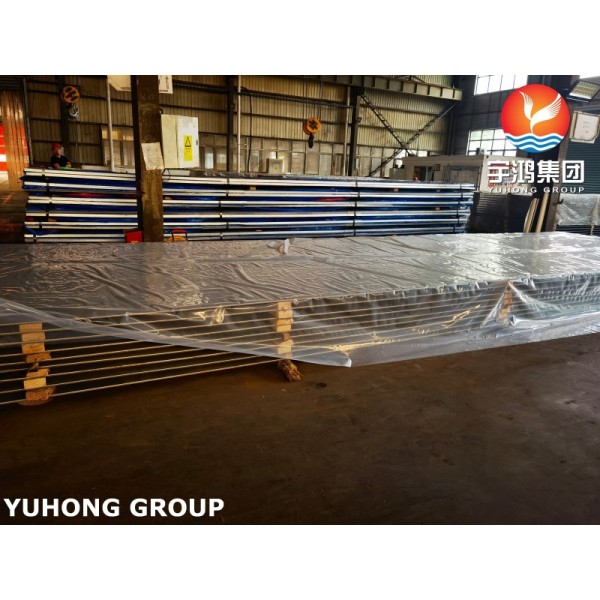
Titanium Steel Clad Plates Cladding Parts SA516 Gr 70 With Gr.2 Explosive Composite
Backing Layer (Substrate): Thick section of SA516 Gr 70 (e.g., 25 mm). Provides the mechanical strength and structural integrity at a lower cost.
Cladding Layer (Liner): Thin layer of Titanium Gr. 2 (e.g., 3 mm). Provides the corrosion resistance.
Interface: A metallurgically bonded, wavy junction created by explosive welding.
Key Advantages:
1. Cost-Effectiveness: You get the corrosion resistance of titanium only where it's needed (the process side), while using much cheaper carbon steel for structural support.
2. Performance: Combines the best properties of both materials—high strength and good toughness from the steel, and superior corrosion resistance from the titanium.
3. Excellent Bond Integrity: Explosive welding creates a bond that is stronger than the weaker of the two parent metals and is highly resistant to disbonding under thermal cycling and stress.
4. Design Efficiency: Eliminates the need for complex corrosion allowances or solid titanium construction, which would be prohibitively expensive and sometimes less strong.
Main Material:
| Base Material | Cladding Material | Size Range | Bonding Methods |
| ASTM A36,ASME SA105 | ASME SB265 | L<12000mm | Explosion bonding |
| ASME SA516 Gr.60, 65, 70,ASME SA350 LF1, LF2, LF3 | Gr.1, 2, 3, 4, 5, 7, 9, 11, 12,16 | W<5000mm | Hot Rolled bonding |
| ASME SA537 Gr.1, 2, 3,ASME SA266 Gr.1, 2, 3, 4,ASME SA387 Gr.11,12,21,22 | Base material thickness:: 7~300mm | Explosion + Hot Rolling | |
| ASME SA240 TP304/304L TP316/316L,ASME SA182 F1, 11, 12, 21, 22, F304/304L, F316/316L | Clad material thickness: 1~12mm |
Primary Applications:
Chemical & Petrochemical Processing: Pressure vessels, reactors, columns, and heat exchangers handling corrosive media (e.g., chlorides, acetic acid).
Offshore Oil & Gas: Seawater handling systems, topside piping, and vessels.
Power Plant FGD Systems: Components exposed to wet sulfuric acid environments.
Pulp & Paper Industry: Bleaching equipment and digesters.
| Method | Explosive Welding | Weld Overlay |
| Bond Strength | Very High | Moderate-High |
| Material Options | Very Wide | Limited |
| Heat Input | None (Cold Process) | Very High |
| Cost | Medium-High | High (Labor) |
| Thickness Control | Excellent | Poor (Uneven) |

|
 Cladding API 5L X65 Carbon Steel Seamless Pipe Cladded With Inconel 625
Carbon Steel Cladding Plate A516 Gr 70 With N04400 One Side Explosive Composite
Explosive Clad Plate ASME SA516 Gr.70 Carbon Steel Cladding ASME SB127 Monel 400
X52 Cladding Inconel 625 Weld Overlay Carbon Steel Seamless Pipe API 5L
Carbon Steel Cladding Nozzle Flange WNRF SA266 Gr.2 SS309L 308L Weld Overlay
Inconel 625 Cladding Flange ASTM A694 F52 Carbon Steel Cladding Weld Neck Flange
ASTM B127 Monel 400 + ASTM A516 Gr.60 Steel Clad Plate Explosive Cladding Pressure Vessel
Weld overlay Tubesheet , ASTM A266 Gr.2 CS Tube Sheet Cladding Stainless Steel
Cladding API 5L X65 Carbon Steel Seamless Pipe Cladded With Inconel 625
Carbon Steel Cladding Plate A516 Gr 70 With N04400 One Side Explosive Composite
Explosive Clad Plate ASME SA516 Gr.70 Carbon Steel Cladding ASME SB127 Monel 400
X52 Cladding Inconel 625 Weld Overlay Carbon Steel Seamless Pipe API 5L
Carbon Steel Cladding Nozzle Flange WNRF SA266 Gr.2 SS309L 308L Weld Overlay
Inconel 625 Cladding Flange ASTM A694 F52 Carbon Steel Cladding Weld Neck Flange
ASTM B127 Monel 400 + ASTM A516 Gr.60 Steel Clad Plate Explosive Cladding Pressure Vessel
Weld overlay Tubesheet , ASTM A266 Gr.2 CS Tube Sheet Cladding Stainless Steel

