| Sign In | Join Free | My infospaceinc.com |
|
| Sign In | Join Free | My infospaceinc.com |
|
| Categories | Dispensing Controller |
|---|---|
| Brand Name: | Mingseal |
| Model Number: | DC600 |
| Certification: | ISO CE |
| Place of Origin: | China |
| MOQ: | 1 |
| Price: | $750-$10000 / pcs |
| Payment Terms: | L/C,D/A,D/P,T/T,Western Union |
| Supply Ability: | 200-300 sets /month |
| Delivery Time: | 5-60 Days |
| Packaging Details: | Wooden Case |
| Dispensing Channel: | Single-channel |
| Power: | 15W |
| Weight: | 2.5KG |
| Company Info. |
| Changzhou Mingseal Robot Technology Co., Ltd. |
| Verified Supplier |
| View Contact Details |
| Product List |
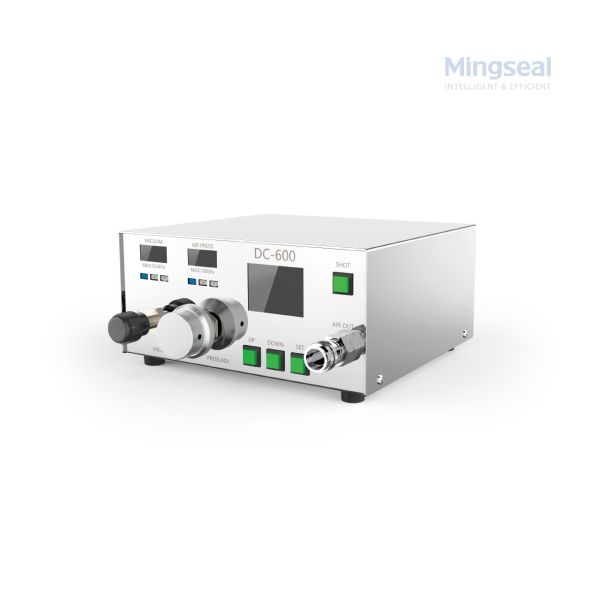
This 15W Automatic Precision Glue Dispensing Controller is designed for high‑repeatability adhesive deposition in electronics manufacturing, including PCB component fixation, connector potting, and small plastic part bonding. The unit provides precise pulse width and pressure control, supports common valve types, stores dispensing recipes for fast product changeover, and offers standard digital and serial interfaces for line integration and traceability.
Problem (one sentence): In electronics assembly, inconsistent glue
volume or placement leads to rework, device failure, and increased
costs.
Cause (one sentence): Variability is often caused by inadequate
pressure resolution, slow valve response, temperature‑dependent
viscosity changes, and lack of inline verification.
Solution (one sentence + steps): The 15 W controller stabilizes
dispensing with fine pulse/pressure control, supports fast valve
drivers to reduce stringing, and enables recipe storage plus
optional inline verification. Implementation steps: 1) select
valve/nozzle matched to required dot size; 2) run a viscosity vs.
temperature characterization; 3) tune pulse width and pressure
during pilot runs and save recipe to MES; 4) use vision or flow
feedback to close the loop where needed.
Precise micro‑dispense control suitable for small‑pitch PCBs and
connector glue dots.
Low power 15 W heater/controller design for compact integration and
lower energy use.
Recipe storage and quick recall for rapid product changeovers.
Multiple I/O and serial protocol options for PLC/MES connectivity.
Reduced stringing and variation when paired with fast valve
cartridges and proper tuning.
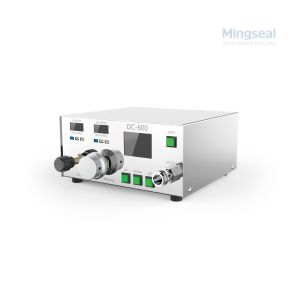
DC600 Desktop Dispensing Controller | |
Dispensing Method | Pneumatic pulse type |
Dispensing Channel | Single-channel |
Dispensing Mode | Timing mode (TIMED) / linkage mode (LINKAGE) |
Input Air Pressure | 0.1-0.7MPa |
Output Air Pressure | 0.05-0.6MPa |
Dispensing Delay Time | 0.01-99.99s |
Operating Power Input | AC220V/50Hz |
Power | 15W |
Dimensions (W*D*H) | 245*192*95mm |
Weight | 2.5kg |
PCB component glue dots for fixation before soldering: reduces
movement and tombstoning risk.
Connector potting and sealing: repeatable bead control for contact
protection.
Small plastic part assembly in consumer electronics and sensors:
compact unit fits inline conveyors and automation cells.
Recipe upload: operator or MES sends pressure/pulse program to the
controller.
Controller action: the unit controls pressure and pulse timing to
the valve driver per channel.
Dispense verification: optional inline vision or flow sensors
measure deposit and provide feedback.
Data logging: parameters and batch info saved for traceability and
QA.
Required deposit volume & tolerance: choose valve/nozzle and ensure
controller resolution meets target repeatability.
Valve compatibility: confirm electrical and mechanical
compatibility with your valve cartridges.
Integration: verify supported protocols (digital I/O,
RS‑232/RS‑485, Modbus) for PLC/MES connection.
Throughput needs: confirm pulse response time and cycle rate to
meet line takt.
Environmental demands: choose enclosure/IP options where dust or
moisture is present.
Commissioning: perform pilot runs for 4–8 hours to stabilize melt
and confirm repeatability; log results to MES.
Maintenance: clean nozzles per adhesive vendor guidance; inspect
seals and valve cartridges on a regular schedule (weekly for
high‑use lines).
Spare parts: stock valve cartridges, seals, filter elements, and
fuses.
Q: What adhesives are supported?
A: Typically supports common electronics adhesives; verify
viscosity vs. temperature and run sample validation before
production.
Q: How do I calculate dispense volume per pulse?
A: Use valve flow characteristic, pressure and pulse width. Perform
a gravimetric or vision measurement during pilot runs to calibrate
and store recipe values.
Q: Can this controller integrate with my MES?
A: Yes — the unit supports standard serial and digital I/O
interfaces; confirm exact protocol options when ordering.
Q: How to reduce stringing?
A: Use fast valve response with optimized pulse widths, maintain
correct glue temperature/viscosity, minimize nozzle‑to‑part
distance, and consider inline vision for closed‑loop correction.
|
 4‑Channel VCM Dispensing Controller (0.05 MPa) — High‑Precision Valve Controller for Micro Dispensing
Liquid‑Level Compensation Dispensing Controller — Air‑Pressure Controlled Automatic Dispenser for Consistent Micro‑Dispense
Flexible 2‑Channel Precision Dispensing Solution for CCM Speaker Assembly
Time‑Pressure Pneumatic Dispensing Controller — 0.6–0.7 MPa Working Pressure, 0.001–999.9s Pulse
VCM SMT Glue Dispensing Controller 0.7 MPa — Precision Dispensing System for TWS, LED & SMT
4‑Channel VCM Dispensing Controller (0.05 MPa) — High‑Precision Valve Controller for Micro Dispensing
Liquid‑Level Compensation Dispensing Controller — Air‑Pressure Controlled Automatic Dispenser for Consistent Micro‑Dispense
Flexible 2‑Channel Precision Dispensing Solution for CCM Speaker Assembly
Time‑Pressure Pneumatic Dispensing Controller — 0.6–0.7 MPa Working Pressure, 0.001–999.9s Pulse
VCM SMT Glue Dispensing Controller 0.7 MPa — Precision Dispensing System for TWS, LED & SMT