Fruit Extractor Separator Machine Three Phase Decanter Centrifugal
Dewatering Centrifuge



Key Features
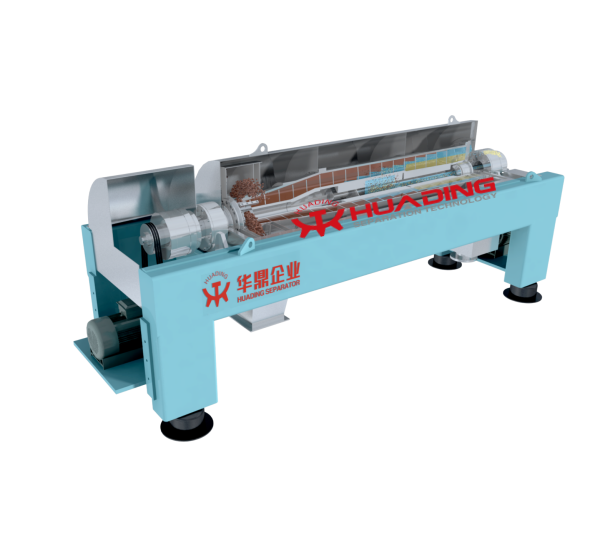
The rotating part of these decanter tricanter centrifuges is
mounted on a compact, in-line frame, with main bearings at both
ends. Vibration dampers are placed under the frame. The rotating
part is enclosed in a casing with a cover and a bottom section with
integrated outlets for both solids and the liquid being removed.
Quality Assurance & Certifications
- JB/T502-2015 Chinese national standard of decanter centrifuge
- 2006/42/EC Machinery Directive
- 2014/35/EU Low voltage Directive
- 2014/30/EU Electromagnetic compatibility Directive
- Quality management system of ISO9001-2000
Technical Specifications
| Bowl Diameter | 186-720mm |
| Bowl Length | 744-3000mm |
| Bowl Speed | 2000-6000rpm |
| G-Force | 1600-4000g |
| Weight | 600-8000kg |
| Primary Motor | 5.5-132kw |
| Secondary Motor | 2.2-45kw |
| Material | AISI 304/316/316L/duplex steel |
| Noise Level | <88db |


Main Components
- Frame
- Gearbox
- Primary motor
- Secondary motor
- Bowl
- Screw
- Hood
Separation Process
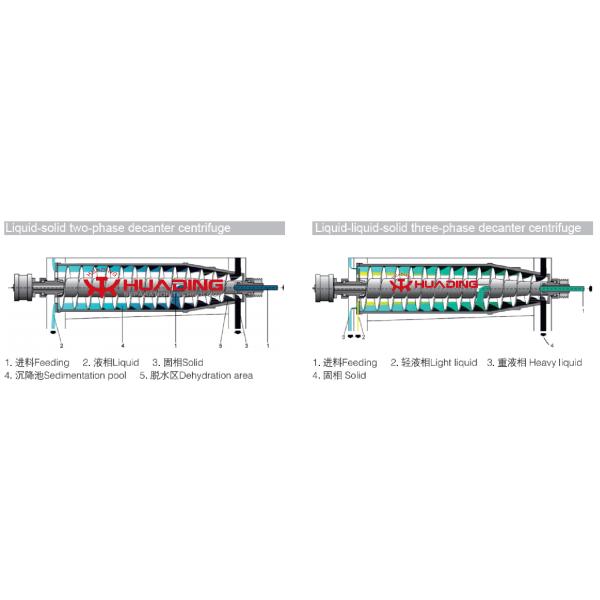
- The feed enters the bowl through a stationary inlet tube and is
accelerated smoothly by an inlet distributor. The centrifugal force
that results from the rotation then causes sedimentation of the
solids on the wall of the bowl.
- Separation takes place in a horizontal cylindrical bowl equipped
with a screw conveyor.
- The conveyor rotates in the same direction as the bowl, but
slightly slower, thus moving the solids towards the conical end of
the bowl. The cake leaves the bowl through the solids discharge
openings into casing.
- The separation process runs through the bowl entire cylindrical
section, clarified liquid is separated by adjustable overflow
plate.
Drive System Options
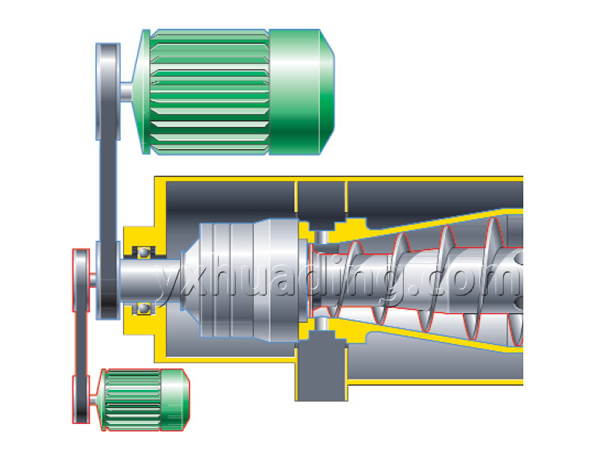
One Motor Drive
This is a very simple design that is cost-effective to purchase and
operate. One motor drive systems are used when the solids volume is
constant, the solids are easy to convey, and requirements regarding
residual water content are not stringent. The input shaft of the
drive is set in motion by the main motor via a second belt drive,
generating differential speed as a function of bowl speed and gear
transmission.

Two Motor Drive
This system enables cost-effective differential speed regulation
under good operating conditions with wide regulating ranges. The
secondary motor sets the input shaft of the gear in motion and
generates differential speed. Two motor drives are used when solid
volumes fluctuate significantly, when solids are conveyed under
difficult conditions, and when stringent requirements apply to
residual water content.
Hydro Drive
This system operates similarly to the two motor drive but uses a
rotating hydromotor supplied with hydraulic regulation by a pump
unit instead of mechanical gear. Because differential speed is
proportionate to the conveyed quantity of oil, automatic regulation
can be provided without any problem.


Frequently Asked Questions
How can we visit your factory?
International visitors arriving at Shanghai Airport or domestic
visitors arriving at Yixing Station will be provided with
transportation to our facility.
How do you guarantee the quality of your products?
With over 60 years of experience, we implement strict quality
policies using advanced processing machines, certified operators,
and internationally renowned components. Comprehensive testing and
inspections are conducted throughout production.
What payment methods does your company accept?
We accept most payment methods, with T/T being the primary method.
How long is the warranty period of your products?
12 months warranty coverage.
I have not done business with your company before, how can I trust
your company?
We have been established on for 14 years and can provide various
business certificates and references.
What are your company's shipping terms and delivery time?
Each unit is custom manufactured with a delivery time of 60-90
days.
Do you give any discount?
We strive to provide the best possible value and pricing for all
our customers.


 CE Horizontal Decanter Centrifuge 3 Phase Coffee Industrial Scale Centrifuge 132 Kw

