| Sign In | Join Free | My infospaceinc.com |
|
| Sign In | Join Free | My infospaceinc.com |
|
| Categories | Dry Mortar Production Line |
|---|---|
| Payment Terms: | L/C,D/P,T/T |
| Mixertype: | Twin shaft mixer |
| Spare Parts: | Send 1 set for free |
| Voltage: | 220V/380V/415V |
| Product Type: | Building materials |
| Model Number: | QC4000 |
| Formula: | Provide |
| MOQ: | 1 |
| Mixing Power: | 22kw |
| Machine Installation Area: | 80-100m2 |
| Price: | 50000-250000 |
| Power: | 80-120kw |
| Application Scope: | Building Industry |
| Certification: | ISO,CE |
| Control System: | Intelligent PLC and computer control |
| Delivery Time: | 7-35work days |
| Material Processed: | Plastics, Chemicals, Other |
| Equipment Material: | Customization |
| Brand Name: | Qingchi |
| Mixing Time: | 2-3min/ batch |
| Raw Material: | Additives,Flyash,Sand Cement Glue Mortar |
| Place of Origin: | Shandong, China |
| Packagingtype: | Automatic packing machine |
| Company Info. |
| Qingdao Qingchi Intelligent Technology Co.,Ltd. |
| Verified Supplier |
| View Contact Details |
| Product List |
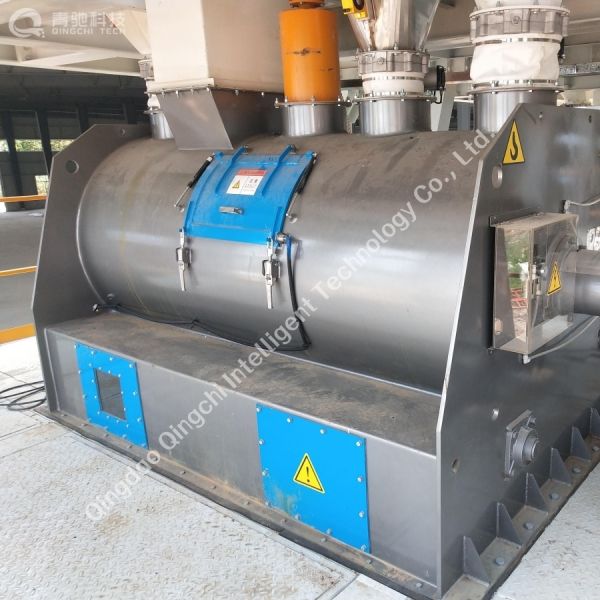
Dry Mortar Mixer is the core mixing equipment for dry‑mix mortar production lines. It is specially designed for dry powder and granular building materials. The machine mixes cement, quartz sand, fly ash, rubber powder, fibers and chemical additives through forced mechanical agitation to produce qualified finished dry mortar.
Adopting mainstream horizontal double‑shaft non‑gravity mixing structure, it can work with batching and discharging modules for integrated operation. It solves the defects of traditional manual mixing such as unstable proportion, poor homogeneity, heavy dust and low efficiency. Suitable for small‑medium batch production and large‑scale automatic production lines. It delivers stable quality and high batch consistency. Finished mortar can be packed in bags for storage or direct on‑site construction. It is widely used in building materials, thermal insulation and decoration industries.
| Item | Specification |
|---|---|
| Model | WZ Series Non‑gravity Dry Mortar Mixer |
| Effective batch volume | 0.5m³‑3m³ (0.8‑5 tons per batch) |
| Hourly output | 3‑30 t/h (depends on model) |
| Mixing motor power | 11kW‑55kW |
| Mixing cycle | 3‑5 min per batch |
| Mixing homogeneity | ≥99% |
| Material residual rate | ≤0.5% |
| Batching accuracy | Aggregate ±1%; Fine additives ±0.5% |
| Working mode | Intermittent automatic / semi‑automatic |
| Applicable materials | Dry powder, fine particles, short‑fiber dry materials |
| Material of construction | Carbon steel main body + wear‑resistant anti‑corrosion lining |
| Noise level | ≤75dB |
Note: Customized specifications are available upon production‑line requirements.
Q1: What is the difference between dry mortar mixer and ordinary concrete mixer? A1: Dry mortar mixer is designed for dry powder and fine‑particle materials. It features high mixing precision and low residual rate for uniform dispersion of trace additives and fibers. Ordinary concrete mixers are for wet concrete with large stones. Their mixing accuracy is insufficient for dry‑mix mortar production and cannot be used interchangeably.
Q2: Why is mixing uneven with color difference and inconsistent batches? A2: Possible causes: incorrect feeding sequence, insufficient mixing time, worn mixing blades, residual old materials inside chamber, over‑loading. Solutions: follow feeding procedure, keep standard mixing time of 3‑5 minutes, inspect and replace worn parts, clean residues and avoid over‑feeding.
Q3: How to handle abnormal noise and heavy vibration during operation? A3: Shut down and cut off power for inspection immediately. Common reasons: foreign metal objects inside chamber, loose blade bolts, bearing wear or insufficient lubrication, loose anchor bolts. Remove debris, tighten fasteners, lubricate or replace bearings and level the machine. Never run with faults.
Q4: High material residue and incomplete discharging, what to do? A4: Standard residual rate ≤0.5%. Excessive residue is usually caused by internal caking, worn lining or blocked discharge port. Clean chamber after each batch; replace severely worn lining and seals.
Q5: Can one mixer produce multiple types of mortar? A5: Yes. It supports ordinary mortar, insulation mortar, tile adhesive, putty powder and other dry materials. Complete cleaning is mandatory before formula switching to prevent cross‑contamination.
Q6: What is the maintenance cycle and routine work? A6: Daily: clean residues, check circuits and components. Weekly: inspect bearings, transmission and seals, apply lubricant. Monthly: tighten bolts, inspect motor and dust‑removal unit. Quarterly: full overhaul of mixing components and replace aging spare parts.
Q7: Low output and high power consumption? A7: Caused by improper feeding, wrong mixing cycle, loose transmission belt, motor aging or internal material caking. Optimize feeding volume and mixing time; maintain transmission system and clear accumulated materials.

|
 20-30Ton/Hour Dry Mortar Production System Full Automatic Dry Mortar Plant
dry mix mortar production line
gypsum powder production line
Ready Mixed Mortar Production Line Semi Automatic Dry Mix Plant
drymix mortar plant
dry mix mortar plant supplier
Containerized Dry Mixed Mortar Production Line 8T/H - 25T/H Output
industrial palletizer
tile adhesive production line
dry mix plant
20-30Ton/Hour Dry Mortar Production System Full Automatic Dry Mortar Plant
dry mix mortar production line
gypsum powder production line
Ready Mixed Mortar Production Line Semi Automatic Dry Mix Plant
drymix mortar plant
dry mix mortar plant supplier
Containerized Dry Mixed Mortar Production Line 8T/H - 25T/H Output
industrial palletizer
tile adhesive production line
dry mix plant

