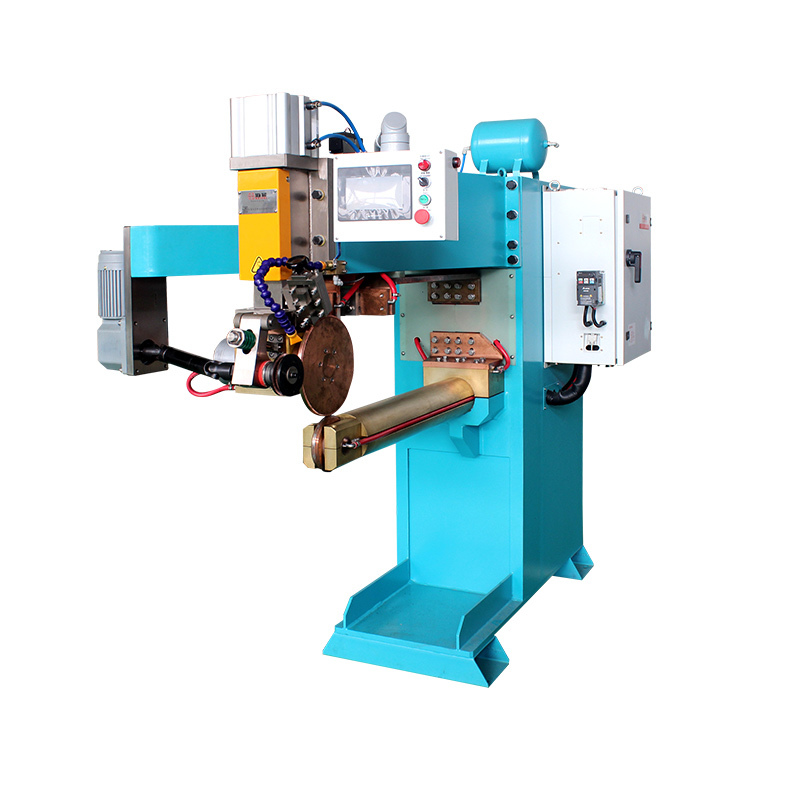
Medium Frequency Longitudinal Seam Rolling Welding Machine
Product Parameters
| Items Model | Unit | FN-100H |
|---|
| Rated capacity | KVA | 100 |
| Power supply | V/Ø/Hz | 380V±10% / 3 phases / 50Hz |
| Rated duty cycle | % | 50% |
| Secondary voltage no load | V | 5.94 - 7.6 |
| Welding thickness | mm | 1.2+1.2 |
| Electrode force Max. | KN | 7 |
| Cylinder stroke | mm | 100 |
| Cooling water consumption | L/h | 1200 |
| Working environment | temperature: 1~45℃ humidity: 35~90% |


Product Overview
The HFFN-100H Medium Frequency Longitudinal Seam Rolling Welding
Machine is engineered for continuous straight-line seam welding of
sheet metal components. This specialized equipment is widely
utilized for longitudinal seams on cylindrical shells, rectangular
ducts, metal tubes, and structural sheet metal parts requiring
uniform weld penetration and stable seam formation.
Unlike spot welding or intermittent joining methods, this machine
focuses on forming continuous welds along fixed linear paths. It is
particularly suitable for applications where structural integrity,
sealing performance, and weld straightness are critical
requirements. The equipment is commonly deployed in HVAC duct
manufacturing, metal pipe production, stainless steel housings, and
industrial sheet metal fabrication lines.
Application Logic Behind Longitudinal Seam Welding
In cylindrical or tubular structures, the longitudinal seam
represents the weakest structural line if not welded properly.
Traditional manual welding often results in uneven seam alignment,
inconsistent penetration depth, heat deformation along joints, and
weak points at welding start/end locations.
The HFFN-100H is specifically designed to address these challenges
by ensuring stable travel speed, consistent pressure application,
and controlled welding energy distribution along the entire seam
length.
Key Features
Stable Linear Seam Formation
Engineered specifically for straight seam welding applications, the
controlled rolling mechanism ensures welding paths remain stable
without deviation, even on extended workpieces. This capability
improves dimensional accuracy and reduces rework caused by
misaligned seams.
Medium Frequency Inverter Control
Utilizing advanced medium frequency technology to stabilize welding
current output, this system provides superior performance compared
to traditional AC welding systems. Benefits include:
- Enhanced energy concentration
- More stable heat input control
- Reduced spatter and deformation
- Improved weld uniformity
Versatile Structural Compatibility
The equipment accommodates both flat sheet welding and cylindrical
longitudinal seams. Typical applications include metal ventilation
ducts, stainless steel tubes, boiler shells, industrial housings,
and structural metal panels.
Improved Welding Consistency
Once welding parameters are established, the machine maintains
consistent pressure and speed throughout the entire seam length.
This automation reduces quality variation caused by operator
differences or manual welding instability.
Reduced Heat Deformation
Long straight seams are particularly susceptible to thermal
distortion in manual welding processes. The controlled energy
output of this system helps minimize deformation, especially when
working with thin to medium gauge sheet metals.
Typical Applications
- HVAC Duct Manufacturing: Longitudinal seams on ventilation ducts requiring airtight
performance and straight seam accuracy
- Metal Tube and Cylinder Fabrication: Stainless steel and carbon steel tubes for industrial piping and
structural systems
- Electrical and Industrial Enclosures: Housings, shells, and structural panels requiring continuous seam
strength
- Boiler and Pressure Components: Longitudinal seams of cylindrical shells requiring stable
structural integrity
- General Sheet Metal Fabrication: Custom metal parts requiring straight-line seam welding
consistency
Frequently Asked Questions
What is this machine mainly used for?
It is used for straight longitudinal seam welding of sheet metal
parts such as ducts, tubes, and industrial shells.
Can it weld cylindrical workpieces?
Yes, it is commonly used for longitudinal seams on cylindrical and
tubular structures.
What materials can it process?
Stainless steel, carbon steel, and galvanized sheet are commonly
supported depending on thickness specifications.
What is the advantage over manual welding?
It provides more stable seam quality, better straightness
alignment, and reduced thermal deformation.