Battery Pack Steel Strap Welding Machine
Technical Specifications
| Item | Specification |
|---|
| Product Name | Battery Pack Steel Strap Welding Machine |
| Welding Type | Resistance Welding |
| Application | Battery pack steel strap and fixing components |
| Workpiece Material | Steel strap, metal fastening parts |
| Welding System | Customized resistance welding system |
| Fixture | Dedicated positioning fixture |
| Operation Mode | Automatic / Semi-automatic |
| Industry | EV battery, energy storage, new energy manufacturing |
Product Overview
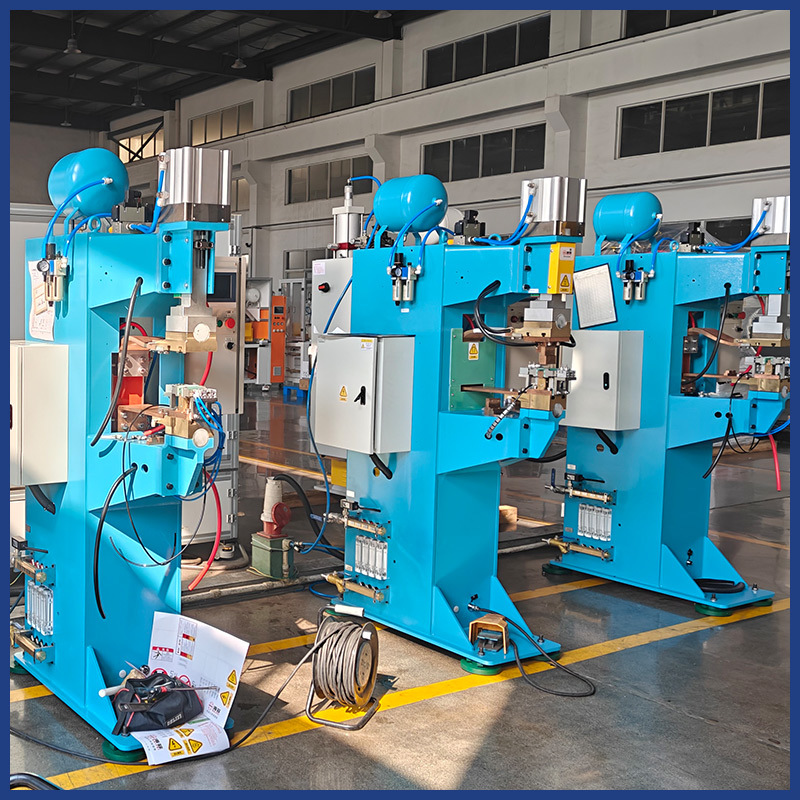
The Battery Pack Steel Strap Welding Machine is a customized
welding system developed for welding steel straps, fixing bands,
and metal fastening structures used in new energy battery
assemblies.
With the rapid development of electric vehicles and energy storage
systems, battery packs require reliable mechanical fixing
structures to maintain stability under vibration, impact, and
long-term operation. The welding quality of steel straps directly
affects the safety and durability of the battery enclosure.
This machine integrates precise positioning fixtures, controlled
resistance welding technology, and automated operation functions to
achieve stable and efficient production of battery pack steel strap
components.
Designed for Battery Pack Steel Strap Welding Requirements
Steel straps used in battery systems usually require strong joints
while maintaining accurate dimensions and reliable assembly
performance.
During traditional production processes, manufacturers may
encounter:
- Inconsistent welding strength between batches
- Strap positioning deviation during assembly
- Low efficiency caused by manual operation
- Difficulty maintaining stable quality in mass production
- Increased inspection workload after welding
The Battery Pack Steel Strap Welding Machine is designed to improve
welding consistency through dedicated tooling and optimized process
control, helping manufacturers achieve reliable production for
battery structural components.
Process Advantages
Controlled joint positioning
The dedicated tooling limits movement between the two strip ends,
helping keep the weld in the specified location.
Reduced distortion around the closure
Support near the welding area helps the band maintain its profile
during electrode pressure and heating.
Recipe-based production
Up to 64 welding programs can be stored for different band
specifications or product versions, reducing repeated manual
parameter entry.
Welding data retention
The controller supports storage of approximately one million
welding records, providing a basis for production review and
process traceability.
Straightforward operation
Once the correct fixture and recipe are selected, the operator
mainly performs loading, cycle confirmation and unloading.
Upgrade path for automation
Part sensing, automatic transfer, unloading, marking and line
communication can be added when the required output justifies a
higher level of automation.
Typical Applications
EV Battery Pack Assembly
Used for welding steel straps and fixing structures applied in
electric vehicle battery pack manufacturing.
Energy Storage Battery Systems
Suitable for battery modules and energy storage systems requiring
stable mechanical fastening solutions.
Battery Structural Components
Applied to metal fixing parts, reinforcement structures, and
supporting components inside battery assemblies.
New Energy Equipment Manufacturing
Used in production lines for battery-related metal structures
requiring reliable welding performance.
Frequently Asked Questions
Q1. Does this machine form the steel strip into a band?
A: The standard HFBGGD-P is intended to weld the closing joint of a
prepared or preformed band. If strip feeding, cutting, forming and
welding are required in one line, those processes can be evaluated
as a separate automated solution.
Q2. Can the band be welded after it has been installed around a
battery module?
A: This depends on electrode access, insulation, nearby components
and the permitted thermal and spatter risk. HAIFEI should review
the complete assembly and process sequence before confirming an
in-place welding solution.
Q3. How are different battery band sizes changed over?
A: Products with similar joint positions may use interchangeable
locating components and separate welding recipes. Large differences
in band shape or electrode access may require a complete fixture
change. Changeover time is confirmed during the design stage.
Q4. Can the machine weld galvanized or coated steel bands?
A: Potentially, but the coating changes contact resistance and
electrode wear. Samples should be tested so that weld strength,
surface condition and maintenance frequency can be assessed before
the machine specification is fixed.
Q5. How is the weld strength confirmed?
A: The inspection method should follow the customer's part
standard. Depending on the joint, verification may include tensile
testing, peel testing, dimensional inspection, visual examination
or section analysis.
Q6. Why use a dedicated machine instead of a standard spot welder?
A: A standard spot welder supplies force and current but may not
control the band shape or closing position. The dedicated machine
combines the welding head with tooling developed for the actual
band, making positioning and repeated production easier to manage.
Q7. What has the greatest influence on the final quotation?
A: Band dimensions, material, joint structure, required output,
number of product variants and automation level are the main
factors. Providing drawings and physical samples makes the
quotation considerably more accurate.
Request a Welding Evaluation
Send us your steel band drawing, material information, joint
details and production target. If samples are available, HAIFEI can
carry out a welding assessment before proposing the fixture layout
and machine configuration.

 Servo Welding Machine with Programmable Electrode Motion, Accurate Force Control, and Real-Time Monitoring for Precision Welding

