| Sign In | Join Free | My infospaceinc.com |
|
| Sign In | Join Free | My infospaceinc.com |
|
| Categories | Titanium Flanges |
|---|---|
| Brand Name: | VOTECH |
| Model Number: | class150 |
| Certification: | ASME,ANSI |
| Place of Origin: | Shaanxi,China |
| Payment Terms: | L/C,D/A,D/P,T/T,etc. |
| Supply Ability: | 100ton/Month |
| Delivery Time: | 7-15 Days |
| Packaging Details: | Export Standard Wooden Case, or Can Be Customized |
| Material Designation: | TA1,TA2,TA9,TA10,GR1,GR2,GR7,GR12,GR16,N5,N6,N7 etc. |
| Size: | NPS 1/2-NPS 6 |
| OEM/ODM: | Available |
| Pressure: | Class 150,Class300 |
| Technics: | Forged |
| Sealing Surface: | RF,FF |
| Company Info. |
| Deko Corporation |
| Verified Supplier |
| View Contact Details |
| Product List |
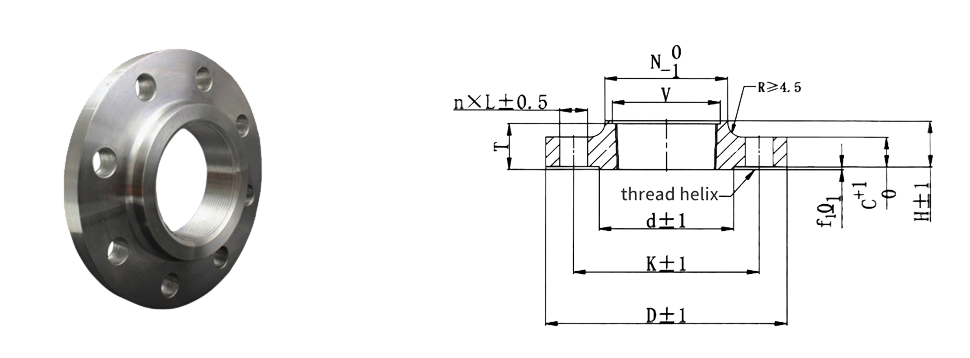
Nominal Dimension | Outer diameter of steel pipe | Connection size | Flange thickness | The large end of the flange neck | Flange height | Pipe thread specification Rc or NPT | |||||
DN | NPS | Flange outer diameter | The diameter of the central circle of the bolt hole | Bolt hole diameter | Bolt | The number of bolt holes | |||||
15 | 1/2 | 21.3 | 90 | 60.3 | 16 | M14 | 4 | 9.6 | 30 | 14 | 1/2 |
20 | 3/4 | 26.9 | 100 | 69.9 | 16 | M14 | 4 | 11.2 | 38 | 14 | 3/4 |
25 | 1 | 33.7 | 110 | 79.4 | 16 | M14 | 4 | 12.7 | 49 | 16 | 1 |
32 | 1-1/4 | 42.4 | 115 | 88.9 | 16 | M14 | 4 | 14.3 | 59 | 19 | 1-1/4 |
40 | 1-1/2 | 48.3 | 125 | 98.4 | 16 | M14 | 4 | 15.9 | 65 | 21 | 1-1/2 |
50 | 2 | 60.3 | 150 | 120.7 | 18 | M16 | 4 | 17.5 | 78 | 24 | 2 |
65 | 2-1/2 | 76.1 | 180 | 139.7 | 18 | M16 | 4 | 20.7 | 90 | 27 | 2-1/2 |
80 | 3 | 88.9 | 190 | 152.4 | 18 | M16 | 4 | 22.3 | 108 | 29 | 3 |
100 | 4 | 114.3 | 230 | 190.5 | 18 | M16 | 8 | 22.3 | 135 | 32 | 4 |
125 | 5 | 139.7 | 255 | 215.9 | 22 | M20 | 8 | 2.3 | 164 | 35 | 5 |
150 | 6 | 168.3 | 280 | 241.3 | 22 | M20 | 8 | 23.9 | 192 | 38 | 6 |

|
 Plate Flat Welding Titanium Flange FF Sealing Surface and OEM Availability
Threaded Titanium Flange with Precise Dimensions for Chemical and Marine Pipeline Systems
Customized Forged Weld Neck Titanium Flange Professional Manufacturer
Titanium Weld Neck Flanges WNRF For High Temperature And High Pressure Piping
ASME Standard Weld Neck Titanium Flange for Pipe Connections
Titanium Weld Neck Flange Pipe Connections for Chemical Ocean Engineering
China OEM Factory Supply Customized Titanium Weld Neck Flange Forged for Oilfield and Natural Gas Use
Custom High Precision Metal Titanium Weld Neck Flange
N5 Technics Premium Titanium Weld Neck Flange for High-Pressure Applications
ASME Standard Customized Precision Titanium Flange Titanium Weld Neck Flange
Plate Flat Welding Titanium Flange FF Sealing Surface and OEM Availability
Threaded Titanium Flange with Precise Dimensions for Chemical and Marine Pipeline Systems
Customized Forged Weld Neck Titanium Flange Professional Manufacturer
Titanium Weld Neck Flanges WNRF For High Temperature And High Pressure Piping
ASME Standard Weld Neck Titanium Flange for Pipe Connections
Titanium Weld Neck Flange Pipe Connections for Chemical Ocean Engineering
China OEM Factory Supply Customized Titanium Weld Neck Flange Forged for Oilfield and Natural Gas Use
Custom High Precision Metal Titanium Weld Neck Flange
N5 Technics Premium Titanium Weld Neck Flange for High-Pressure Applications
ASME Standard Customized Precision Titanium Flange Titanium Weld Neck Flange

