| Sign In | Join Free | My infospaceinc.com |
|
| Sign In | Join Free | My infospaceinc.com |
|
| Categories | Dry Mortar Production Line |
|---|---|
| Delivery Time: | 7-35work days |
| Mode Of Operation: | continuous type |
| Color: | Grey/White/Blue Or Customized |
| Year: | 2024 |
| Model Number: | QC3000 |
| Speed Of Mixing: | 30.5r/min |
| Price: | 50000-250000 |
| Dimension: | 58445*12376*18704 mm |
| Working Cycle: | 150 s |
| MOQ: | 1 |
| Batching And Packing: | Auto |
| Power: | 80-120KW/ 220-440Hz, 50/60Hz |
| Payment Terms: | L/C,T/T,Western Union |
| Mixingtype: | Twin shaft mixer / Planetary mixer |
| Packing Machine: | Valve Port Packing Machine |
| Equipment Material: | Customization |
| Certification: | ISO,CE |
| Mixing Type: | Double Paddle Shafts Mixer |
| Place of Origin: | Shandong, China |
| Cover Area: | 50-200㎡ |
| Dustcollector: | Included with bag filter system |
| Brand Name: | Qingchi |
| Voltage: | Customized 220V/380V/415V |
| Company Info. |
| Qingdao Qingchi Intelligent Technology Co.,Ltd. |
| Verified Supplier |
| View Contact Details |
| Product List |
The dry mortar production line is a complete integrated industrial production system specially designed for mass manufacturing of dry-mixed and pre-mixed construction mortars. It adopts a modular and automated production process covering raw material storage, precise batching, conveying, homogeneous mixing, finished material storage and automatic packaging. Equipped with a core twin-shaft paddle mixer, the system realizes accurate proportioning and full uniform mixing of sand, cement, fly ash, mineral powder and various functional additives. The whole production process adopts closed operation with intelligent PLC control, effectively solving the problems of traditional manual mixing such as unstable proportion, uneven mixing, low efficiency and serious dust pollution. This full-process automatic production line can stably produce various ordinary and special mortars, and is widely applicable to medium and large-scale standardized production of building mortar in construction materials factories.
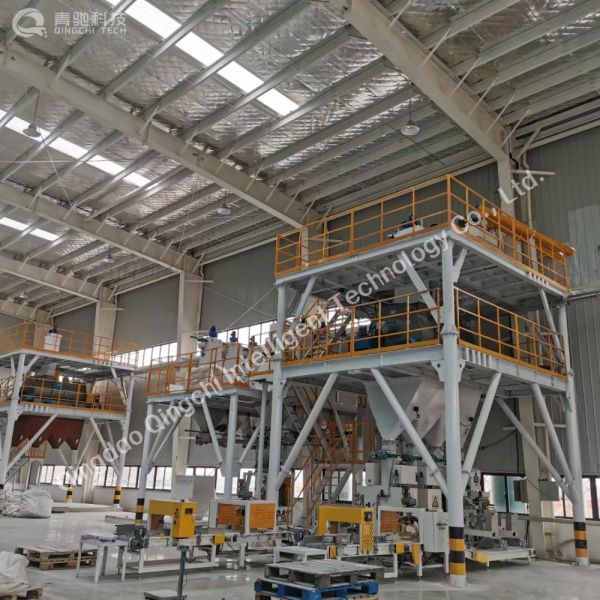

| Item | Technical Parameters |
|---|---|
| Production Capacity | 1-30t/h (customizable) |
| Control System | Full-automatic PLC intelligent control |
| Batching Accuracy | Main materials: ±0.2%; Micro-additives: ±0.1% |
| Mixing Uniformity | CV ≤5% |
| Single Batch Mixing Time | 30-60s |
| Core Mixing Host | Twin-shaft counter-rotating paddle mixer |
| Feeding Mode | Bucket elevator + screw conveyor automatic feeding |
| Packing Speed | 30-60 bags/h (25-50kg per bag) |
| Dust Removal Mode | Bag-type pulse dust removal |
| Working Mode | Continuous automatic cycle production |
| Applicable Materials | Ordinary dry mortar, special functional mortar, powder building materials |
| Equipment Power | Customized according to production capacity |
A: This production line supports the production of almost all dry-mixed mortars, including ordinary masonry and plastering mortar, as well as special mortars such as waterproof, thermal insulation, anti-crack, self-leveling, tile adhesive and putty powder. It can realize multi-formula switching production to meet diversified market demands.
A: The main causes include inaccurate batching parameters, insufficient single-batch mixing time, serious wear of mixing paddles, residual caking materials in the cylinder and uneven feeding of additives. Solutions: calibrate the batching system regularly, adjust the mixing cycle, replace worn parts in time, and clean the equipment thoroughly after each use.
A: Dust leakage is mainly caused by aging sealing strips, blocked dust removal equipment or untight closing of maintenance doors and feeding ports. It can be solved by replacing damaged sealing parts regularly, cleaning the dust removal filter cartridge timely and checking the tightness of each connecting port before startup.
A: The whole line adopts intelligent PLC one-key control with simple operation and low labor dependence. The modular structure is convenient for daily cleaning and parts replacement. Equipped with automatic fault alarm function, it can quickly locate problems and greatly reduce maintenance difficulty and time cost.
A: Yes. We provide full personalized customization services. The production line capacity (1-30t/h), equipment configuration, layout mode and supporting systems can be adjusted according to customers’ site space, product types and production scale to meet different production demands.
A: The integrated automatic production line realizes unified batching, mixing and packaging, with higher production efficiency and more stable product quality. It solves the problems of low precision, serious dust pollution, high labor cost and unstable batch quality of traditional single equipment, and is more suitable for large-scale, standardized and green industrial production.

|
 20-30Ton/Hour Dry Mortar Production System Full Automatic Dry Mortar Plant
dry mix mortar production line
gypsum powder production line
Ready Mixed Mortar Production Line Semi Automatic Dry Mix Plant
drymix mortar plant
dry mix mortar plant supplier
Containerized Dry Mixed Mortar Production Line 8T/H - 25T/H Output
industrial palletizer
tile adhesive production line
dry mix plant
20-30Ton/Hour Dry Mortar Production System Full Automatic Dry Mortar Plant
dry mix mortar production line
gypsum powder production line
Ready Mixed Mortar Production Line Semi Automatic Dry Mix Plant
drymix mortar plant
dry mix mortar plant supplier
Containerized Dry Mixed Mortar Production Line 8T/H - 25T/H Output
industrial palletizer
tile adhesive production line
dry mix plant

