Short Circuit Protected Dustproof PLC Control Cabinet Assembly For
Mechanical Processing Workshop
The Short Circuit Protected Dustproof PLC Control Cabinet Assembly is engineered specifically for harsh industrial environments, such
as CNC machining, metal cutting, and automated fabrication
workshops. Mechanical processing generates high concentrations of
conductive metallic dust, fine particulate matter, and ambient oil
mist. When airborne dust penetrates standard electrical enclosures,
it causes dielectric breakdown, tracking resistance loss, and
catastrophic short circuits.
This integrated control cabinet combines high-breaking-capacity
short-circuit protection, sealed NEMA 12 / IP65 enclosure
construction, and modular PLC automation control. It delivers
uninterrupted control signal processing and robust circuit
protection under heavy mechanical vibration and particulate
exposure.
Technical Specifications
| Parameter / Feature | Engineering Specification |
|---|
| Ingress Protection Rating | IP65 / NEMA 12 (Dust-tight, oil-resistant, water-jet protected) |
| Short-Circuit Current Rating (SCCR) | 35kA to 65kA RMS symmetrical at 480V AC (IEC / UL compliant) |
| Main Enclosure Material | 2.0mm Cold-Rolled Carbon Steel with Epoxy-Polyester Powder Coating
(SS304/SS316 optional) |
| PLC System Architecture | Modular S7-1200/1500 or AB CompactLogix |
| Operating Voltage | 380V / 400V / 480V AC, 3-Phase, 50/60Hz |
| Control Circuit Voltage | 24V DC Regulated Power Supply |
| Protection Components | Molded Case Circuit Breakers (MCCB), Type 2 Surge Protection
Devices (SPD), Thermal Overload Relays |
| Thermal Management | Sealed Industrial Air Conditioner / Heat Exchanger with
positive-pressure airflow |
| Sealing System | Seamless Polyurethane (PU) Foam Gasket (Continuous Robot-Poured) |
| Compliance & Standards | IEC 61439-1/2, UL 508A, CE Low Voltage Directive 2014/35/EU |
| Operating Temperature Range | -10°C to +55°C (+14°F to +131°F) |
Core Operational Problems Solved
1. Dielectric Short Circuits from Metallic Airborne Dust
The Challenge: Fine iron shavings, aluminum dust, and carbon particles enter
unsealed cabinets through cable glands and door gaps, causing
phase-to-phase arcing across terminal blocks.
The Engineering Solution: The cabinet features a continuous, robotically applied
polyurethane foam door gasket paired with double-lip sealing
channels. Combined with IP68-rated compression cable glands, the
interior maintains a zero-particulate boundary, blocking conductive
dust migration to electrical terminals.
2. High Short-Circuit Fault Currents & Equipment Damage
The Challenge: Heavy machinery startup and line surges in workshops can spark
localized short circuits, melting internal wiring and damaging
expensive PLC I/O modules.
The Engineering Solution: Coordinated protection architecture utilizes current-limiting
MCCBs and fast-acting fuses rated up to 65kA SCCR. Isolation
transformers and optical isolation on 24V DC input/output channels
shield the central PLC processing unit from voltage spikes and
fault backfeeds.
3. Thermal Overheating in Sealed Environments
The Challenge: Fully sealing an electrical cabinet traps heat generated by
Variable Frequency Drives (VFDs), power supplies, and PLC modules,
leading to thermal tripping.
The Engineering Solution: Closed-loop air conditioning or air-to-air heat exchangers
circulate internal cabinet air separately from ambient workshop
air. This keeps internal temperatures stable without introducing
external shop dust.
Engineering Field Application & Deployment Case
Deployment Scenario: Automotive CNC Engine Block Machining Line
Operating Environment: High-speed aluminum and cast-iron milling workshop operating 24/7.
High ambient coolant mist, metal swarf, and constant vibration.
Existing Failure Mode: Standard IP54 control panels suffered monthly shutdowns caused by
fine metallic dust accumulating on the main busbar and PLC terminal
cards.
Implementation Configuration:
- Custom 2000mm x 800mm x 600mm dual-door control assembly
- Integrated S7-1500 PLC with remote I/O drops
- Sealed 1.5kW enclosure air conditioner mounted on the side panel
- Main incoming breaker rated at 50kA SCCR with Type 2 Surge
Protective Devices
Operational Results: The closed-loop positive sealing structure eliminated particulate
entry into the PLC chassis. The modular wiring layout simplified
routine maintenance inspections to scheduled quarterly visual
checks without emergency downtime.
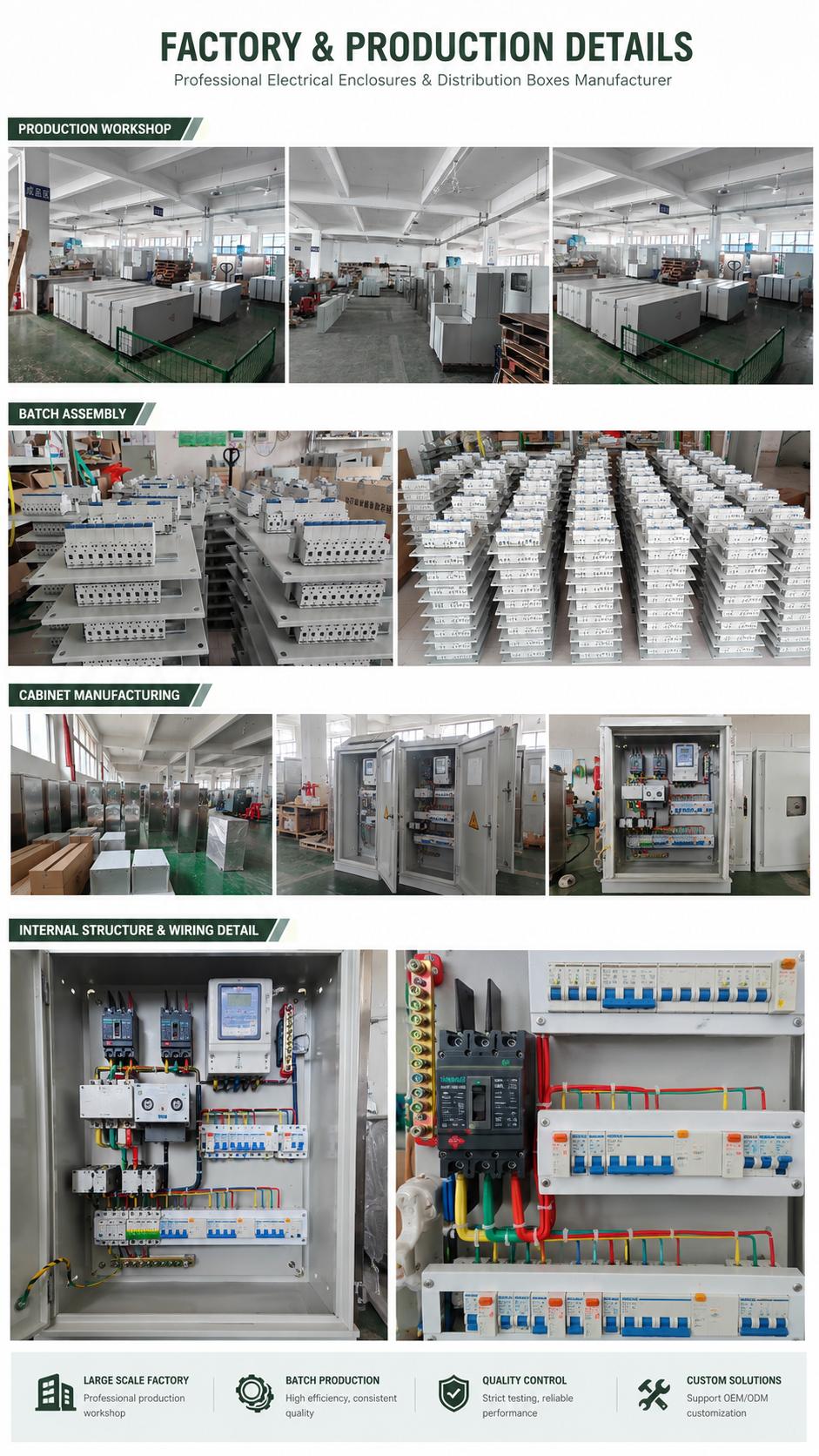
Internal Architecture & Component Engineering
Continuous Gasket & Structural Integrity
- Frame Construction: 16-fold profile steel frame provides structural rigidity under
heavy mechanical vibration
- Door Hinging & Latching: 3-point lock systems ensure uniform compression across all four
edges of the continuous PU gasket
Electrical Wiring & Cable Routing
- DIN Rail Organization: Segregated high-voltage (480V 3-phase power) and low-voltage (24V
DC PLC logic) wire ducts to eliminate electromagnetic interference
(EMI)
- Wire Marking & Ferrules: Flame-retardant DIN 46228 halogen-free insulated end ferrules with
heat-shrink identification tags on every terminal
Grounding & EMC Shielding
- Equipotential Bonding: Braided copper grounding straps connect all cabinet doors, side
panels, and mounting plates directly to the main copper earth
busbar
Frequently Asked Questions (FAQ)
How does this control cabinet achieve a dustproof seal while
cooling internal electronics?
The cabinet uses closed-loop thermal management. Internal air
circulates through a sealed heat exchanger or panel air conditioner
without mixing with external shop air. The internal loop cools
heat-generating components (like VFDs and power supplies) while
maintaining an IP65/NEMA 12 barrier against external dust and oil
mist.
What short-circuit protection mechanisms are installed inside the
assembly?
The assembly integrates coordinated multi-stage short-circuit
protection. This includes a primary Molded Case Circuit Breaker
(MCCB) configured for high short-circuit interrupting capacity (up
to 65kA at 480V), individual miniature circuit breakers (MCBs) for
control branch circuits, and isolated 24V DC power supply modules
equipped with short-circuit foldback protection.
Can this cabinet be customized for specific PLC brands and workshop
space constraints?
Yes. The physical dimensions, plate thickness, terminal
configurations, and PLC hardware ( AB, Schneider, Mitsubishi, or
Omron) are tailored during panel layout design. Panel drawings
comply with IEC 61439 and UL 508A standards prior to metal
fabrication and electrical assembly.
How often should the dust seals and thermal systems be inspected in
a machining environment?
In high-particulate metal processing workshops, visual inspection
of external air conditioner condenser filters is recommended
monthly. The polyurethane door gaskets and compression cable glands
should be inspected annually during scheduled plant maintenance to
verify sealing elasticity and latch compression.

 Secure Lock Anti Vibration PLC Cabinet Assembly For Mining Automatic Control System

