| Sign In | Join Free | My infospaceinc.com |
|
| Sign In | Join Free | My infospaceinc.com |
|
| Categories | Printing Labeling Machine |
|---|---|
| Model Number: | YM320P |
| Function: | Ahesive Sticker Labeling |
| MOQ: | 1 SET |
| Delivery Time: | 30 Work days |
| Advantage: | 20 Years Experiences(High Speed+High Accuracy+High Quality+Customized) |
| Printing technology: | Thermal Transfer, Direct Thermal, Customized |
| Payment Terms: | L/C,D/A,D/P,T/T |
| Material: | 304Stainless Steel+Aluminum Alloy |
| Weight: | 210kg |
| Certification: | CE Certificate |
| Keyword: | label printer Sticker Machine |
| Brand Name: | YIMU |
| Product name: | Automatic barcode label printing machine |
| Price: | $5999-$7499/1set |
| After Warranty Service: | Online Video Technical, Video Support Online Support |
| MOQ: | 1 Set |
| Supply Ability: | 1000Sets / year |
| Machine Size: | 1670*1500*1600mm |
| Place of Origin: | Shanghai, China |
| Label accuracy: | 1mm |
| Packaging Details: | WOODEN CASE |
| Operation: | 1 Person Easy |
| Company Info. |
| Shanghai Yimu Machinery Co., Ltd. |
| Verified Supplier |
| View Contact Details |
| Product List |
Barcode labeling requires line-of-sight scanning — each barcode must be individually visible to a scanner, one at a time. For inventory counting, receiving dock scanning, or retail checkout, this line-of-sight limitation translates to labor hours spent positioning and scanning individual items.
RFID (Radio Frequency Identification) eliminates the line-of-sight constraint. An RFID reader can simultaneously read hundreds of tagged items within its field — without opening boxes, without orienting products, without individual scanning. Inventory counts that take hours with barcode scanners take minutes with RFID. Receiving dock verification becomes a drive-through operation. Retail checkout becomes a walk-through experience.
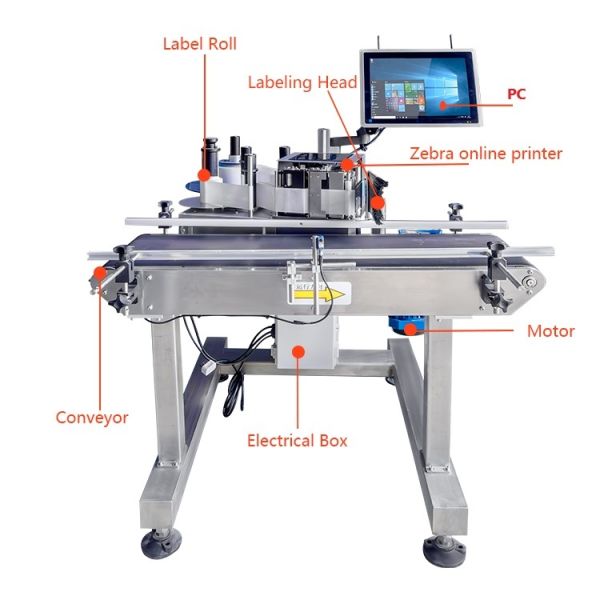
The YM320P, when configured with a Zebra RFID-enabled industrial printer, combines traditional label printing with UHF RFID tag encoding in a single print-and-apply operation. Each label that the machine applies carries both a printed barcode (for environments where barcode infrastructure exists) and an encoded RFID tag (for environments transitioning to RFID or requiring dual-format identification).


The integrated Zebra RFID printer contains an RFID encoder module that communicates with the RFID chip embedded in the label material (commonly called an "inlay"). The encoding process executes in parallel with label printing:
| Parameter | Specification |
|---|---|
| Frequency | UHF 865-928 MHz (region-specific) |
| Tag Types Supported | Inlay-based UHF RFID labels, on-metal tags, item-level tags |
| Memory Encoding | EPC (up to 496 bits), User Memory (up to 512 bits, tag-dependent), Access/Kill passwords |
| Encoding Speed | ~100-200ms per tag (simultaneous with printing) |
| Verification | Read-after-write verification with automatic overstrike on failure |
| Data Source | Database-driven (SQL/CSV), auto-increment, or fixed EPC pattern |
Case-level and pallet-level RFID tagging enables:
The YM320P's print-and-encode capability supports a practical transition strategy: print both an RFID tag and a barcode on the same label. This dual-format approach allows:
The printed barcode content and encoded RFID content can be identical or complementary.
Q: Can the YM320P handle on-metal RFID labels?
A: The YM320P's Zebra printer handles standard UHF RFID label rolls. For on-metal applications, specialized RFID labels with foam or ferrite backing are required. These are thicker than standard labels . Confirm your on-metal label material specifications with our engineering team during the quotation process to ensure compatibility with the machine's label path.
Q: What RFID frequency and protocol does the YM320P support?
A: The integrated Zebra RFID printer operates in UHF (865-928 MHz), with the specific frequency range configured per your region (FCC for North America, ETSI for Europe, etc.). The encoder supports EPC Gen2v2 (ISO 18000-63) protocol. For HF (13.56 MHz / NFC) encoding requirements, contact our engineering team for a custom solution evaluation.
Q: What happens if an RFID tag fails to encode?
A: The Zebra printer performs read-after-write verification on every tag. When a tag fails encoding (typically <0.5% failure rate with quality RFID labels), the printer can be configured to overstrike the label with a "VOID" pattern and automatically retry encoding on the next label. The machine logs all encoding failures for quality tracking.
Q: Can we encode different EPC formats for different products on the same machine?
A: Yes. EPC encoding formats — SGTIN-96, GRAI-96, SSCC-96, GIAI-64, or custom formats — are defined per product recipe in the YM320P's HMI. When you switch products (via a 60-90 second recipe change), the encoding format switches automatically with the label template.
Q: Can you help us select the right RFID label material for our application?
A: Yes. We encourage you to send sample products to our Shanghai engineering center. Our engineers will test multiple RFID inlay and label material combinations with your products, evaluate read range and encoding reliability, and recommend the optimal configuration. This testing is performed before delivery so your machine arrives pre-validated for your specific RFID labels.
Q: Do you provide RFID label stock, or do we source it separately?
A: We can supply validated RFID label rolls tested for compatibility with your YM320P, or you can source RFID labels from your preferred supplier — we will validate third-party label compatibility during pre-shipment testing with your supplied label samples.

|
 Boxs Coffee Bag Bottle Printing Labeling Machine Sticker OEM ODM
Electric Square Bottle Packaging Labeling Machine For Round Container 20pcs/min
PLC Water Bottle Printing Labeling Machine 203DPI 300DPI 600DPI
High Speed Printing Labeling Machine Applicator For Plastic Bottle Box 100Pcs/Min
50pcs/Min Packaging Label Printing Machine For Rectangular Round Container
Multifunctional Printing Labeling Machine Sticker for Cardboard Box container
Industrial Package Labeling Machine For Bottles Printing Pharmaceutical Grade
100pcs/Min Industrial Bottle Printing Labeling Machine PLC HMI Control
CE Certificated Thermal Label Label Printing Equipment For Square Bottles Sticker Packaging
Automatic Sticker Printing Label Machine Thermal Transfer For Small Business Packaging
Boxs Coffee Bag Bottle Printing Labeling Machine Sticker OEM ODM
Electric Square Bottle Packaging Labeling Machine For Round Container 20pcs/min
PLC Water Bottle Printing Labeling Machine 203DPI 300DPI 600DPI
High Speed Printing Labeling Machine Applicator For Plastic Bottle Box 100Pcs/Min
50pcs/Min Packaging Label Printing Machine For Rectangular Round Container
Multifunctional Printing Labeling Machine Sticker for Cardboard Box container
Industrial Package Labeling Machine For Bottles Printing Pharmaceutical Grade
100pcs/Min Industrial Bottle Printing Labeling Machine PLC HMI Control
CE Certificated Thermal Label Label Printing Equipment For Square Bottles Sticker Packaging
Automatic Sticker Printing Label Machine Thermal Transfer For Small Business Packaging

