| Sign In | Join Free | My infospaceinc.com |
|
| Sign In | Join Free | My infospaceinc.com |
|
| Categories | Steel Flange |
|---|---|
| Yield Strength: | 15 Min ksi |
| Connection: | Welding, Threaded, Slip On, Socket Weld, Lap Joint |
| Shape: | Weld Neck |
| Material: | C70620 |
| Tensile Strength: | 40 Min ksi |
| Brand Name: | YUHONG |
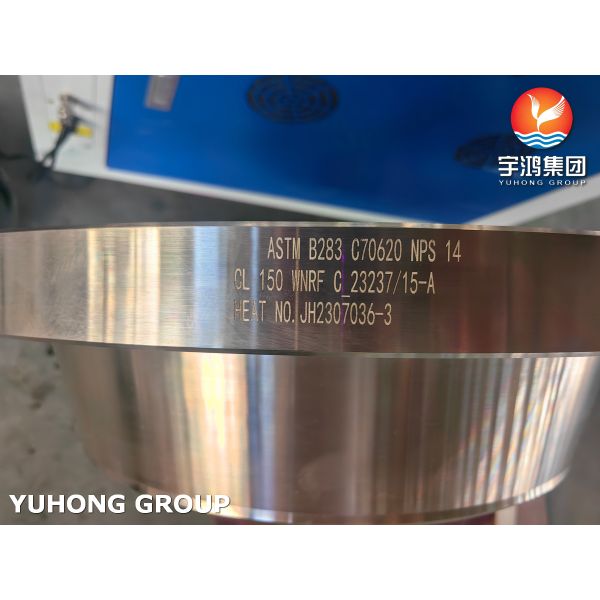
| Model Number: | ASTM B283 C70620 FLANGE |
| Certification: | ABS, GL, DNV, NK, PED, AD2000, GOST9941-81, CCS, ISO 9001-2015 |
| Place of Origin: | China |
| MOQ: | 500KGS |
| Price: | NEGOTIABLE |
| Payment Terms: | L/C,T/T |
| Supply Ability: | According To Client's Request |
| Delivery Time: | 10-90 Days |
| Packaging Details: | Ply-wooden Case /Iron Case/ Bundle with plastic Cap |
| Class: | 150#--15000# |
| Company Info. |
| Yuhong Group Co.,Ltd |
| Verified Supplier |
| View Contact Details |
| Product List |
The ASTM B283 standard refers to the specifications for copper and
copper alloy seamless and welded pipe, fittings, and flanges.
C70620 is a specific alloy designation under the copper family.
UNS C70620 alloy is an alloy of copper (the largest single base
metal) and nickel, with or without other elements, of which zinc
may not exceed 1%. When other elements are present, nickel is
second only to copper in individual content compared to the others.
As with other copper alloys, it is necessary to distinguish between
wrought alloys processed into semi-finished products and cast
alloys produced by various casting processes. Copper-nickel alloys
with the addition of manganese are important in electrical
engineering. The addition of iron significantly increases the
corrosion resistance of copper-nickel alloys in flowing seawater
and other corrosive waters.
Copper alloys have very good resistance to seawater, brines,
organic compounds, salts, dilute non-oxidizing acids, etc. UNS
C70620 is a copper-nickel-iron alloy with a low manganese content
that has excellent resistance to seawater and brackish water. Of
all commercial copper alloys, CuNi 70/30 (C71500) has the best
resistance to aqueous corrosion. It is resistant to acid solutions
and highly resistant to stress corrosion cracking and impact
corrosion. In addition, CuNi70/30 provides greater strength for
higher pressures.
It's important to note that this type of steel needs proper heat
treatment to achieve its full mechanical properties and should be
used with care to prevent cracking during welding or fabrication
processes. Always consult the specific manufacturer's guidelines
for best practices and application recommendations.
A "WN RF" flange refers to a type of flange. "WN" stands for "weld
neck," which means that the flange is attached to a pipe by welding
onto a weld neck that extends from the pipe. "RF" stands for
"reduced face," indicating that the flange has a reduced diameter
at the flange face, which provides better fluid flow
characteristics than a full face flange.
| Elements | |||||||||
|---|---|---|---|---|---|---|---|---|---|
| Cu(1,2) | Pb | Zn | Fe | P | Ni(3) | C | Mn | S | |
| (1) Cu value includes Ag. (2) Cu + Sum of Named Elements 99.5% min. (3) Ni value includes Co. | |||||||||
| Min (%) | 86.5 | 1.0 | 9.0 | ||||||
| Max (%) | 0.02 | 0.50 | 1.8 | 0.02 | 11.0 | 0.05 | 1.0 | 0.02 | |
| Form | Temper | Temper Code | Tensile Strength (ksi) | YS-0.2% Offset (ksi) | Elongation (%) | Section Size (in) |
|---|---|---|---|---|---|---|
| * Measured at room temperature, 68°F (20°C). | ||||||
| Forgings | As Hot Forged - Air Cooled | M10 | 40 Min | 15 Min | 30 Min | |
| As Hot Forged - Air Cooled | M10 | 45 Min | 18 Min | 30 Min | 6 | |
The hot strength of copper increases with the addition of only a small amount of nickel. The mechanical properties are improved by the addition of iron, not only at room temperature, but also at elevated temperatures. 10% nickel. For example, CuNi10Fe1Mn can be used for pressure vessel structures up to 300°C, and CuNi30Mn1Fe up to 350°C. Above these limiting temperatures, the strength decreases significantly, especially the creep strength and creep strain limit.
In general, heat treatments are only used for copper-nickel alloys for soft annealing and stress relief. The temperature of the recrystallization annealing can vary in a wide range between about 620 and 900°C, depending on the degree of cold working, the nickel content and other components. High temperatures are associated with short annealing times (continuous annealing), low temperatures with long annealing times (static annealing). Stress relief annealing is carried out at 280 to 500°C. It is recommended to anneal in an atmosphere excluding air or slightly reducing to avoid pickling in an annealing atmosphere containing air.

|
 ASTM A182 F304/304L,F316/F316L Stainless Steel Flanges SORF / SOFF / WNRF Type AD2000 Certification ISO Certificate
STAINLESS STEEL FLANGE,SORF,WNFF,DIN2573,A182, F304, 304L, 304H, SS316, 316L ,B16.5
ASTM B151 C70600 Copper Nickel Alloy Forged Flange SCH80 CL150 Weld Neck Rised Face B16.5
ASTM A105 Carbon Steel Forged Flange BLRF SORF WNRF Black Painted
ASTM A105 Carbon Steel Slip On Raised Face Forged Flange Black Painted
ASTM B462 Hastelloy C276 Nickel Alloy UNS N10276 Weld Neck Flange WNRF
Good Corrosion Resistance ASTM A182 F316L Forged Spectacle Flange
ASME SA182 F317L WN RF Stainless Steel SMLS Flange , Bridas
ASME SA350 LF2 Class 1 Alloy Steel Forged Flange For Low Temperature
ASTM A182 F317 F317L Blind RF SS Forged Flange Bridas

