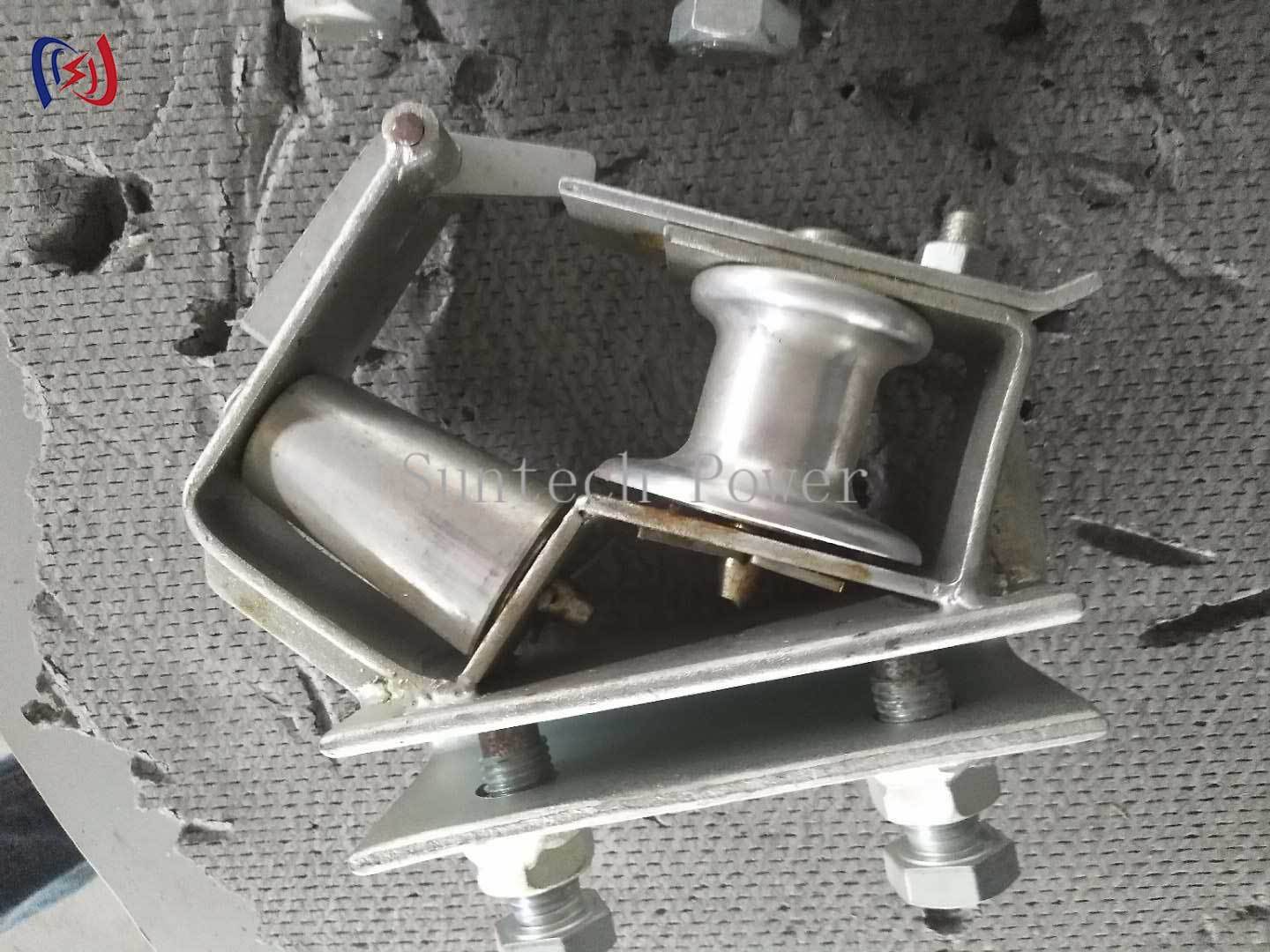
Sky Corner Stringing Block for Angle Poles and Obstacle Crossings
A corner block does not see the conductor tension, it sees roughly
twice that multiplied by the half angle. At a 90 degree corner the
resultant on the block is about 1.41 times the line tension, which
is why a 5KN corner block belongs on distribution and small
conductor work rather than on a transmission pull. This sky corner
block is built for exactly that duty: SHCZ-0.5 with an aluminium
roller and SHCZN-0.5 with a nylon roller, both for LGJ 25 to 185
conductor, 5KN rated, 1.8kg to 2.4kg, with a hook ring plate hanger
that takes a standard crossarm or pole band.
Model Data
| Item No. | Model | Suitable Conductor (LGJ) | Rated Load (kN) | Weight (kg) | Roller |
| 10281 | SHCZ-0.5 | 25 - 185 | 5 | 2.4 | Aluminium |
| 10282 | SHCZN-0.5 | 25 - 185 | 5 | 1.8 | Nylon |
Roller diameters are supplied from 100mm to 280mm to suit the
conductor and the corner angle; the 280mm units are used where the
conductor has to keep a generous bend radius at a tight corner.
The Load at the Corner
Resultant on a corner block is 2T x cos(θ/2), where T is the
conductor tension and θ is the angle between the two conductor
legs. At 120 degrees included angle the block sees 1.0T, at 90
degrees it sees 1.41T, and at 60 degrees it sees 1.73T.
Practically: with a 5KN block, keep the conductor tension at or
below about 3.5KN when the corner is 90 degrees, and below 2.9KN
when the corner closes to 60 degrees. If the pull needs more than
that, use a larger block or set the corner with the conductor
supported on two blocks.
Setting the Corner Block Correctly
On the bisector: hang the block on the bisector line of the corner so the resultant
passes through the hook ring rather than across it. A block hung
off the bisector loads the hook in bending, which is the most
common way a corner block fails in service.
Clear of the pole and the crossarm edge: the roller groove has to sit outside any steel or concrete
surface, or the conductor will rub on the structure instead of the
roller once tension comes on.
Pin the hook: the hook ring plate must be closed or pinned before the pull
starts; an open hook can walk off a bolt when the conductor snaps
into line.
Control the angle during the pull: the block rotates as the conductor comes into line, so the crew
has to watch the roller and re-seat it if the conductor rides
against a side flange.
Choosing Roller and Roller Material
Roller diameter should be at least fifteen times the conductor
diameter to stay inside the bend allowance, so LGJ 185 wants a
240mm to 280mm roller. Nylon is the better choice for aluminium and
coated conductor because it does not mark the strands and there is
no galvanic couple; aluminium holds its groove longer when the same
corner is used repeatedly with steel rope or abrasive pulls, and it
dissipates heat better on a long drag.
Urban Work and Obstacle Crossings
For street corners and span crossings the corner block keeps the
conductor off road surfaces, walls and roof edges. Set the block
high enough that the sagging conductor clears traffic and
pedestrians through the whole drag, and use a second roller where
the conductor changes plane, because a single roller cannot guide a
conductor that turns in two directions at once.
Inspection and Service
Check the hook ring for wear and elongation, confirm the roller
turns freely and shows no flat spot, and inspect the groove for
burr from splice sleeves. Rollers and bearings are replaceable
service parts, and the frame is galvanized steel with a painted
finish option for coastal depots.
Packing and Supply
Blocks are packed in plywood cases, with the roller protected from
impact. Monthly capacity is around 5000 pieces, delivery 5 to 7
days, minimum order 1 piece, and OEM marking or packing marks can
follow the buyer's drawing.
Frequently Asked Questions
Can the block be used at a 45 degree corner? Yes, but the resultant
rises to about 1.85T, so reduce the line tension accordingly or
move to a higher rated block.
Is a three roller corner set available? Yes, a multi roller corner
assembly is available for phase conductors that have to turn
together.
Which model suits LGJ 120? SHCZN-0.5 with a 160mm to 200mm nylon
roller covers it well.

 100A Grounding Block: Triple Sheave Conductor Stringing Pulley for Induced Electricity Removal

